Do you think the Buggery Law should be?

The Safe House Homeless LGBTQ Project 2009 a detailed look & more


In response to numerous requests for more information on the defunct Safe House Pilot Project that was to address the growing numbers of displaced and homeless LGBTQ youth in Kingston in 2007/8/9, a review of the relevance of the project as a solution, the possible avoidance of present issues with some of its previous residents if it were kept open.
Recorded June 12, 2013; also see from the former Executive Director named in the podcast more background on the project: HERE also see the beginning of the issues from the closure of the project: The Quietus ……… The Safe House Project Closes and The Ultimatum on December 30, 2009

Monday, November 1, 2010

I am Visible Bisexual campaigns begins .....

0 comments


About ‘I am Visible’

'I am Visible' Logo

The ‘I am Visible’ campaign is about making a difference in the lives of the bisexual community.

Though, we feel we are part of the gay, lesbian, transgender, and straight communities, we also know that there has been a high level of intolerance of late—particularly in our gay and lesbian communities in print, Web, entertainment, politics, and social media. We have become invisible regarding all forms of media, (straight or gay).

We have been invisible in entertainment regarding key bisexuals coming out or celebrities and politicians, that have opted to come out, and the response within the community on a whole—non belief, biases regarding bisexuals which are seen to be lying and will soon move over to being gay or lesbian, or they are just seeking attention using the “B” card.

BIPHOBIA

The ‘I am Visible’ campaign is for anyone who have been misrepresented, miscounted and ignored, when there have been clear signs of being bisexual or pansexual have been shown.

The ‘I am Visible’ campaign is for many that has been bullied, called out for not being real, or hated against for speaking on bisexual rights regarding key issues on equality—causes such as “Don’t Ask, Don’t Tell,” marriage rights, bullying for being bisexual and all causes that our allies in all communities seek justice for.

These in fact are the causes that bisexuals feel strongly in representing and yet are called out as not being apart of the cause, because of opposite-sex bisexuals who are dating or marriage.

BI-ERASURE

The ‘I am Visible’ is for bisexuals to be able or to be allowed to speak out in national campaigns where gay and lesbians are offered asked to attend as guest speakers and yet there in no representation of any important leader of the bisexual and pansexual communities; and not be called into question should they be there—or not even approached to be present because of bias and misunderstanding of who bisexuals really are.

The ‘I am Visible’ campaign is for all who have become invisible because of bisexual misunderstanding or not wanting to understand or just blatant denial that bisexuals even exist. Or if we should be apart of the gay and lesbian community.

The ‘I am Visible’ campaign is for all those regardless of age, race, group, sexuality, same-sex or opposite sex individuals who feel bisexuals have a place to debate, share their lives, participate, be seen in all things of straight and gay media, entertainment, (movies, books, television, radio, internet), politics, social lives and the every day—this movement for you. Join us!

Transgender man playing NCAA women's basketball

0 comments

Kye Allums, the NCAA’s first Div. 1 publicly transgender basketball player, is starting conversations never before held in the sport.

By Cyd Zeigler

Not many people noticed a slight change on the George Washington University website earlier this year. It concerned a player on the school’s women’s basketball team named Kay-Kay Allums. Just a couple letters were taken away, a Y was moved and an E was added to form the player’s new name: Kye Allums. To most people it was meaningless, but to Allums the change was the most significant of his lifetime.

“A name is just a bunch of letters, but the letters make up a word and the words that make up my name have so many more emotions behind them,” Allums said. "My old name, that’s just not me. When I hear Kye, everything feels okay, everything is right.”

For the last 20 years, Kay-Kay Allums had appeared to the world as female. She was born with the anatomy that other women have. Her mom tried to dress her in only the most feminine clothes. But inside was a man waiting to burst out of the female body he was born in.

On Nov. 13, Kye Allums will introduce himself to the NCAA basketball world at the Best Buy Classic in Minneapolis in a game against the University of Wisconsin-Green Bay. When he steps foot on the court, Allums will be the first publicly transgender person to play NCAA Div. 1 college basketball.
Allums grew up in the small town of Hugo, Minn., a half hour north of Minneapolis. Head coach Mike Bozeman scheduled the tournament appearance as a homecoming for him, long before he transitioned to male. The junior guard’s inaugural game identifying as a man will also be the first time he has played in front of his hometown crowd. While Allums is making a change now, most of his family and friends will recognize him as the same old Kye.

Growing up, Allums was a tomboy. The oldest of four kids, he would often say he was a boy despite being born a biological girl. Around age 12, he realized that no other girls behaved or dressed the way he did, so he adopted some of the trappings of other girls his age: Putting on make-up, wearing skirts and dresses. After just a year of putting up a feminine front, it was back to the tomboy clothes and wondering why he just didn’t fit in.

“I’ve always felt most comfortable dressing like a boy, but my mom would take all of my clothes from me and she’d force me to wear girl clothes,” Allums said. “I’d bring sweats and basketball shorts and put them in my backpack. I’d just change every day when I got to school, and I had to change back before I went home. It was annoying, but it was the only way I could go to school.”

In high school, Allums met other people who acted and dressed like him: They were lesbians. For the next few years Allums identified as lesbian, finally fitting into a group that he could define. As he progressed deep into his teens, despite their similar dress and manner, he realized he just didn’t fit with the lesbians at his school either.

It was a text message from his mother during his freshman year at George Washington that flipped the switch. They were in
a fierce texting battle when his mother wrote, “Who do you think you are, young lady?” The answer was suddenly crystal clear to h
im: He wasn’t a young lady at all.

“I used to feel like trans anything was really weird and those people were crazy, and I wondered, ‘How can you feel like that?’” Allums said. “But I looked it up on the Internet and I thought, ‘Oh my god, I’m one of those weird people.’ And I realized they’re not weird. It’s all in your mindset and how you think.”

Early in his sophomore year, Kye began to emerge. When people referred to Allums as “she” or “girl,” he was quick to correct them. He distanced himself from the name Kay-Kay.

“When people refer to me as ‘girl’ or ‘she,’ it doesn’t sit well with me,” Allums said. “That feeling you get when someone pisses you off, that feeling you get when your stomach gets hot and it aches, that’s what it feels like. And that’s how I know I’m not supposed to be a girl. If I was, I’d be walking around like everybody else, getting make-up and doing my nails. But it doesn’t sit well with me.”

It was during his sophomore year that Allums told some teammates he was a man inside a woman’s body. At first, they didn’t believe him. They joked with him about it. But Allums was serious, and when he is on a mission everyone takes notice.

“We were all just talking, a bunch of teammates, and he said that he’s a guy,” said teammate Brooke Wilson, one of Allums’ closest friends on the team. “At first I didn’t understand, and then he explained that sex is how you’re born and gender is how you identify yourself. Then I started to understand.”

Allums began to correct everyone who referred to him with female pronouns; everyone, that is, except his head coach. The person Allums feared telling the most was Bozeman. Comments from the coach about religion had made Allums feel a little uneasy. He didn’t think his head coach would ever be able to wrap his head around the idea that he was coaching a man on a women’s team. Eventually, the internal pressure to be himself became too great for even Allums’ stubborn strength to repress.
“I was gonna have to hide a piece of me that was really important,” Allums said. “All my teammates knew. I don’t like keeping things from coach; I’m a very open person. It got to the point where I decided I wasn’t going to go through a whole season with my coach not really knowing me, even though I knew it would probably make him feel uncomfortable.”

The moment of truth came one day in June when Bozeman tracked down Allums in his dorm room to talk about another issue. When Allums eventually turned the topic to his transition, it became a difficult conversation. Allums explained, as best he could, that he was a man and had always been a man. When Bozeman asked Allums if God made a mistake, he didn’t know how to respond. It wasn’t going well. But at some point in the conversation, the tone changed.

“Why would you think I wouldn’t have your back?” Allums remembered Bozeman asking. “I’ve had your back through everything. Our relationship has grown from nothing to this, and now you think I’d just turn my back on you because you told me this? No. I love you and I’ll always be here for you.”

A request made through the university to speak to Bozeman was denied. Instead, Bozeman released this statement: “The George Washington University women’s basketball program, including myself, support Kye’s right to make this decision.”

Allums realizes now he should have known better than to assume the worst from his coach.

“Everybody’s pretty much accepting of everyone on the team. Everybody is different,” said Wilson. “We’re teammates, we’re like family. It’s a bunch of brothers and sisters. Everybody brings their life and issues to the family.”
In this basketball family, Allums has become the eccentric big brother. He’s the only player whose major, Interior Design, is artistic in nature. And when teammates get new boyfriends, they have to run them by Allums for approval. Having grown up taking care of his younger siblings, it’s a role that comes naturally.

“If you mess with one of my teammates,” Allums said, “you’re going to have to deal with me.”

Approaching his first women’s basketball season as a man has its potential dilemmas. At the top of the list is the use of locker rooms. While women’s teams have traditionally used the women’s locker room, Washington, D.C., law ensures individuals “the right to use gender-specific restrooms and other gender-specific facilities such as dressing rooms… that are consistent with their gender identity or expression.”

Candace Smith, spokesperson for George Washington University, said, "The university will work with Kye and Kye’s teammates on these issues."

Some opposing fans will be licking their chops to hurl other names at Allums. He has already heard taunts from fans for years: With a masculine build, opposing fans regularly try to insult him, calling him a “man.” What those fans don’t know is that Allums relishes it.

“I love it,” Allums said. “I say, ‘Yeah, you’re right.’ It makes me feel better about myself to hear them call me a man.”

As Allums’ teammate, Wilson doesn’t expect to hear anything the team hasn’t already had to handle.

“They say things about me, they say things about coach, they say things about everybody,” Wilson said. “We’ve been through it all.”

Allums, who started 20 of his team’s 28 games last year, said it’s rare that he hears smack talk from opposing players. According to NCAA spokesperson Jennifer Royer, players are expected to adhere to the NCAA’s code of conduct on the court, and transphobic language falls under that code.

“In addition to educational sessions at the NCAA Convention, Gender Equity and Issues Forum, and other conferences and seminars, [the NCAA] Constitution addresses the principle of sportsmanship and ethical conduct, which outlines the NCAA’s expectation that student-athletes and others associated with athletics programs will adhere to values such as respect and civility,” Royer said.

At some point, questions will come as to whether Allums should be allowed to play on the women’s team. Losing his scholarship was a real concern for Allums just six months ago as the task of fully expressing himself while still playing basketball seemed overwhelming. As he’s educated himself, that fear has dissipated.

In October, the National Center for Lesbian Rights released a report called, “On The Team: Equal Opportunity for Transgender Student Athletes,” in conjunction with It Takes A Team. The report was developed with the help of many subject-matter experts, including the NCAA. One recommendation of the report is for schools to adopt polices that “focus on maximizing inclusiveness, rather than restricting students’ opportunities to participate based on their gender identity or expression.”

According to Royer, as long as Allums does not accept hormone treatments, he is eligible to participate in NCAA women’s sports.

“As the NCAA continues to examine best practices for transgender student-athlete participation,” Royer said, “the member schools are advised to consider the gender classification of student-athletes’ state identification documents, such as driver’s licenses and voter registration, to determine appropriate participation.”

Allums is further protected by Washington, D.C., law, which prohibits discrimination based on gender identity.

The issue remains a complicated one for many to grasp. One coach who asked to remain anonymous said he might have a problem if a team in his conference had a player who identified themselves as a man. The reasoning: Because Allums identifies as a man, everyone should treat him as such and he should be playing men’s sports. Still, Allums’ education is on the line, and he has a scholarship to play on the women’s basketball team. No such scholarship has been extended for him to play on the men’s team.

“There’s not just a one-sentence answer,” said former NCAA basketball head coach Helen Carroll, who co-authored NCLR’s trans-athlete report. “It’s much more complicated than him being a man so he should play men’s sports. Kye as an athlete should have an opportunity to play sports. Period. What that looks like gets complicated because Kye is a transgender athlete.”

Allums has been aware of NCAA regulations for years, and he’s made plans around them. Circled on his calendar is the last possible date he could play in an NCAA game, in April 2012: That’s the date he can begin hormone treatment. Between now and then, he does plan to have sex-reassignment surgery next summer before he plays out his senior season.

“The only thing I can’t do is take testosterone,” Allums said. “And I don’t need that anyway. I probably naturally have more than some of the guys on the guys’ team. If I get surgery, it doesn’t affect my play, it doesn’t enhance anything, I’m just taking something off my body, like if I lost a finger.”

Through all of this, Allums continues to struggle with the “trans” identity. He doesn’t understand why he has to be labeled by some people as “transgender” or “transsexual.” He sees nothing wrong with the label, and his days of viewing trans people as “weird” are long behind him. But at this point in his life, he sees himself as a guy, not “female-to-male.”

Allums does have a regret on his journey. It came when his head coach asked him if he thought God had made a mistake. He’s given that question a lot of thought, and he wishes he could have given a better answer.

“God didn’t make a mistake,” Allums said. “I was meant to be like this for a reason. Clearly my life is going to be different from anyone who was born a biological male, because of what I’ve been through. And I was meant to go through all of this.”

Longer Hep C Treatment Improves Response in People Coinfected With HIV

0 comments
People coinfected with both HIV and hepatitis C virus (HCV) who fail to respond rapidly to HCV treatment are more likely to achieve a cure for their HCV if they extend their treatment by at least six months. These data were presented at the American Association for the Study of Liver Diseases being held October 29 to November 2 in Boston.
Treatment for hepatitis C has both benefits and disadvantages. When it works well—called a sustained virological response (SVR) and defined as achieving and maintaining undetectable HCV levels for at least six months after completing a course of treatment—it cures people of their infection. The treatments can be quite toxic, however, and they must be taken for at least six months. Moreover, they frequently fail to work for people infected with genotypes 1 and 4, especially in people infected with both HIV and HCV.

The current recommended course of HCV treatment in coinfected individuals, which consists of pegylated interferon combined with ribavirin, is 48 weeks. Generally, about 40 to 50 percent of people with genotypes 2 or 3, and about 25 to 30 percent of people with genotypes 1 and 4, achieve an SVR. Recent research has found that people who have a rapid virological response (RVR), which is an undetectable HCV level four weeks after starting treatment, are far more likely to have an SVR after completing treatment.

To determine the likelihood of achieving an SVR, based on a person’s rapid response, and to determine whether adding an additional three or more months of HCV treatment would help boost treatment responses in people who failed to control their HCV well in the first few weeks of therapy, Pablo Barreiro and his colleagues enrolled 185 HIV and HCV coinfected people into the EXTENT study. Six possible courses of treatment were available to participants, depending on their genotype, their RVR and their virological response at 12 weeks.

In people who achieved an RVR, those with genotypes 2 or 3 continued HCV treatment for a total of six months, while those with genotypes 1 or 4 continued treatment for one year.

People who failed to achieve an RVR, and who had less than a 2 log drop in HCV levels by week 12, stopped treatment regardless of their HCV genotype.

People who failed to achieve an RVR, but who did see a 2 log or greater drop at week 12 continued on until the six month point, when their HCV levels were tested again. Those who still had measurable HCV levels stopped treatment. Those who had undetectable HCV levels either remained on therapy for a total of 48 weeks (genotypes 2 or 3) or 72 weeks (genotypes 1 or 4).

The EXTENT study had several notable findings. First, a rapid virological response significantly predicted the likelihood of curing a person’s hepatitis. In those with genotypes 2 or 3, a full 66 percent achieved an SVR after just six months of treatment, and 65 percent of those with genotypes 1 or 4 achieved an SVR after 12 months of treatment. In the genotype 1 or 4 group, this represents a nearly 250 percent increase in efficacy over standard cure rates for such individuals.

Second, an additional length of treatment helped improve cure rates in people who initially failed to achieve an RVR. Seventy-seven percent of those with genotypes 2 or 3 achieved an SVR with the longer 48-week duration of treatment, while 62 percent of those with genotypes 1 or 4 achieved an SVR after 72 weeks of treatment.

In contrast, the standard treatment duration worked miserably in people who initially failed to control virus at four weeks. Just 17 percent of those with genotypes 2 or 3 achieved an SVR after six months of treatment, and only 9 percent of those with genotypes 1 or 4 had an SVR after the standard 12 months of therapy.

These data offer hope and guidance to people coinfected with HIV and HCV who cannot wait for newer HCV therapies to become available and who must decide whether to start HCV treatment and how long to take it.

Friday, October 29, 2010

Rejected Lesbian Lover Jumps From roof .............

0 comments


Two St James women, an 18-year-old and her grandmother, both ended up spending time in hospital earlier this week after the teen jumped from the roof of a house after her girlfriend ended their relationship.

Residents of Paradise in Nor-wood, Montego Bay, St James, told THE WEEKEND STAR that on Monday about midday, the teenager and her 20-odd-year-old lover who were sharing a home for over a year got into an altercation.

It is said that the lover expressed a desire to end the love affair. Her desire is said to have been more than just word of mouth as she is said to have packed some clothes and left the house.

The heartbroken teenager is then said to have gone on to the roof of the house and jumped off, crashing to the ground. She was rushed to hospital and according to the residents her legs were broken in the fall.

After hearing that she was injured, the grandmother of the teenager is reported to have turned up at hospital where she heard persons saying that her granddaughter was a lesbian.

The 60-odd-year-old woman is said to have fallen to the ground. She reportedly hit her head and ended up in the hospital.

"Di grandmother nuh live a Norwood still eno, but everybody know seh di two girl dem a lesbian. Dem nuh hide it and dem even live together so mi cyaa see how di granny shock til' she all drop down," Timmy, a resident said.

Residents and police personnel from the Montego Bay CIB say that the incident has since become a hot topic in the community. "A formal report was not made but we have heard of the incident. A lot of people are talking about it," an officer at the Montego Bay CIB said when contacted.

Efforts to confirm the teen's injuries were unsuccessful up to press time last night as hospital personnel said that information regarding patients could not be divulged over the telephone.


ENDS

Pity we do not have any serious interventions at this time apart from referalls that often do not help enough or go far enough to deal with same sex relationship issues or conflict resolution that spill into the public domain. Rejections does not seem to be taken likely in our community due to the limited socialization leading to long term unions I surmise as living openly is already hard to navigate in our homophobic and growing lesbophobic society.


Young same gender lovers also need to have some guidance as to how to navigate and face certain realities especially in in the ending of a relationship or at best trial separation as an option as well. We all at some point want a life partner especially here so as to find solace from the problems of not being out and proud so some persons based on my observation find redress in a sense in a union and sexual contact. What tends to happen however also is a heteronormative construct being applied to how gay persons live out their relationships, so there is a dominant partner, gender roles mimicked in the union and a fatalistic approach when an abrupt end occurs or one partner is found to be cheating with the corresponding rage acted out in public as we have also seen in previous cases and tabloid entries such as this one:

Butch finds herself in some trouble for "non disclosure"

Much more work is needed to help persons involved gay romantic relationships. 

Peace and tolerance

H

Thursday, October 28, 2010

Being Accountable to the Invisible Community: A Challenge for Intersex Activists and Allies

0 comments

Intersex conditions are relatively rare, but not that rare. To give you an idea, there we e about 8,000 intersex people living in the state of Florida alone during the 2000 Presidenti l Election, which means that intersex people could have tipped the election to Al Gore if th y voted in a block! (To which my cleve friend said, "but if intersex people were voting in a block, they will find a way to disqualify intersex votes.")

Of course, there has never been an intersex voting block, or even an intersex political action committee. Indeed, despite the fact that there are tens of thousands of intersex people in this country, only a small number of people have publicly come out as "intersex." Where are the rest of intersex people?

Some do not know that they have an intersex condition, either because they have not been properly diagnosed or have not been told by their doctors and parents about their condition. Some do know about the condition that they have, but do not know that their condition may be considered part of intersex. Some reject the term "intersex" because of its negative association with "hermaphrodite" and other freaky imagery. For many, intersex is a site of pervasive physical and sexual violation, which they do not want to re-visit at all. Some wish to push away intersex as something that has happened in the past. Some are struggling hard just to stay alive. Some feel isolated and alienated by everyone around them, and do not feel that it is possible to "come out."

When we talk about intersex, we are talking about a lifelong history of shame, secrecy and isolation that are imposed on children who were born with slightly different bodies. We are talking about childhood sexual trauma, dirty family secret, repeated stripping in examination rooms, and the knowledge that whatever body you were born with was defective on arrival. It is not surprising that most people born with intersex conditions do not identify as "intersex" either publicly or privately.

As a result, the demographics of the few intersex activists who "come out" is skewed to be: mostly white, often college-educated, often LGBT or genderqueer (because queer people are already familiar with the process of coming out and doing activism, and also because they are more willing to go outside of standard sex/gender categories). This group, however, does not necessarily represent the rest of the people who are born with intersex conditions.

I personally do not consider "intersex" to be part of my identity. I feel that intersex is something that was done to me, not who I am. Nonetheless I am publicly "out" as an intersex activist, because I feel that taking such position is useful politically. Once people recognize me as an intersex activist, I can then start talking about what I actually feel about the label.

This creates a problem for the people who want to become allies to the intersex movement. If the few "out" intersex activists do not represent the rest, where should allies draw guidance as to what to do? How can allies act responsibly to the people who do not speak out?

As a relatively well-known intersex activist, I have come in contact with many people with intersex conditions who are not otherwise "out" as intersex or do not identify as intersex. Some of these people participate in condition-specific (such as CAH and AIS) support groups, while others are completely isolated. Even with the insight coming from these meetings, I am still unsure sometimes if certain things I say or do is actually in the best interest of intersex people as a whole.

There are some things that I am absolutely certain, such as that clitoral genitoplasty and vaginoplasty on a child is a bad idea. This is supported by many stories I have heard as well as the latest medical researches. But on other topics, such as when there was a discussion about whether or not to include "intersex" in PFLAG, I have had to make a judgment call based on everything I know about the situation and my own personal conviction.

As an ally, you will not get to hear from 99% of the people you are working to advocate for. But you are still accountable to them, as I am to my less vocal peers. Your best guide, aside from what "out" intersex activists will tell you, is your common sense.

Common sense should tell you that intersex people are regular people just like everyone else. Some are male, some are female, and there are few who explore alternative gender categoriesNjust like the non-intersex population. Some are gay or lesbian, some are bisexual, and some are straight. It makes no sense to assume that someone is gay or transgender because s/he is intersex, because a) there are gays and transgender people who aren't intersex, and b) there are intersex people who are not gay or transgender.

Common sense should tell you that whether or not one's genitalia matches her or his gender identity is not the only thing that matters. The problem with the intersex surgery is that it's harmful and in violation of the child's right to self-determination. The risk of assigning the "wrong gender" is not the only argument against thissurgery, nor is it the biggest one.

Common sense should tell you that using intersex babies to argue for some abstract theory or someone else's agenda, such as the social acceptance of a "third gender," is wrong. Most intersex people live happily as women or men just like everyone else, although they may be unhappy about the shame, secrecy and isolation that were imposed on them through medicine. If we were to advocate for the social acceptance of "third gender," that should be the responsibility of adults, whether intersex or not, rather than that of intersex children.

This is just the beginning. Use your common sense and focus on how to improve the lives of people with intersex conditions now and in the future. Ask us questions, but sometimes be willing to question the answers coming from the few "out" intersex activists including myself.

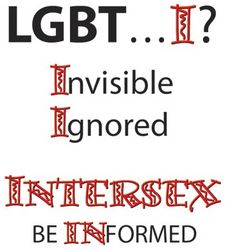
Intersex Awareness Day - Oct 26th

0 comments
Apologies for missing this important date been busy working and probing so many other issues and stories.


Celebrate Intersex Awareness Day!

Intersex Awareness Day is the (inter)national day of grass-roots action to end shame, secrecy and unwanted genital cosmetic surgeries on intersex children. We intend to create a "day of action" similar to Take Back the Night, National Coming Out Day, or International Women's Day in that it will focus on grass-roots activism organized by local activists.

To learn about intersex issues/experiences in general, please see any of the following websites:

Bodies Like Ours
Intersex Initiative
Intersex Society of North America
Frequently Asked Questions

What is intersex?
Intersex refers to a series of medical conditions in which a child's genetic sex (chromosomes) and phenotypic sex (genital appearance) do not match, or are somehow different from the "standard" male or female. About one in 2,000 babies are born visibly intersexed, while some others are detected later. The current medical protocol calls for the surgical "reconstruction" of these different but healthy bodies to make them "normal," but this practice has become increasingly controversial as adults who went through the treatment report being physically, emotionally, and sexually harmed by such procedures.

Beside stopping cosmetic genital surgeries, what are inter sex activists working toward?
Surgery is just part of a larger pattern of how intersex children are treated; it is also important to stop shame, secrecy and isolation that are socially and medically imposed on children born with intersex conditions under the theory that the child is better off it they didn't hear anything about it. Therefore, it's not enough to simply stop the surgery; we need to replace it with social and psychological support as well as open and honest communication.

What's so significant about October 26?


On October 26, 1996, intersex activists from intersex society of naughty america (carrying the sign "Hermaphrodites With Attitude") and our allies from Transexual Menace held the first public intersex demonstration in Boston, where American Academy of Pediatrics was holding its annual conference. The action generated a lot of press coverage, and made it difficult for the medical community to continue to neglect our growing movement. That said, events related to Intersex Awareness Day can take place throughout October and does not necessarily have to be on the 26th.

It's great! How can I help?
First,join our email discussion list (we suggest the digest format if you want to keep the number of emails you receive under control). Then, look at our Get Involved section to see if there is already any IAD events scheduled for your area. If so, go and help them; if not, find a local organization that will sponsor the event--for example, try LGBT group in your city or college campus--and help them bring IAD to your city! We have suggestions for what activities to do, but what you will do is entirely up to you and your neighbors (and please tell us if you think of any great idea!)

Please note that Intersex Awareness Day is a loosely networked national initiative, and there is no central "headquarters." The form below will send an email to the maintainer of this web site, who is not necessarily "in charge," so to speak, of any activities that we are not directly involved. That said, we try to hook up local activists together so that we can all have a wonderful Intersex Awareness Day this year.


from Queers United
What is intersex?
Intersex refers to a series of medical conditions in which a child's genetic sex (chromosomes) and phenotypic sex (genital appearance) do not match, or are somehow different from the "standard" male or female. About one in 2,000 babies are born visibly intersexed, while some others are detected later. The current medical protocol calls for the surgical "reconstruction" of these different but healthy bodies to make them "normal," but this practice has become increasingly controversial as adults who went through the treatment report being physically, emotionally, and sexually harmed by such procedures.

Beside stopping cosmetic genital surgeries, what are intersex activists working toward?
Surgery is just part of a larger pattern of how intersex children are treated; it is also important to stop shame, secrecy and isolation that are socially and medically imposed on children born with intersex conditions under the theory that the child is better off it they didn't hear anything about it. Therefore, it's not enough to simply stop the surgery; we need to replace it with social and psychological support as well as open and honest communication.

What's so significant about October 26?
On October 26, 1996, intersex activists from Intersex Society of North America (carrying the sign "Hermaphrodites With Attitude") and our allies from Transexual Menace held the first public intersex demonstration in Boston, where American Academy of Pediatrics was holding its annual conference. The action generated a lot of press coverage, and made it difficult for the medical community to continue to neglect our growing movement. That said, events related to Intersex Awareness Day can take place throughout October and does not necessarily have to be on the 26th.

Peace and tolerance

H

Does size matter? - The women speak

0 comments
By DONNA HUSSEY-WHYTE
Observer's All Woman writer

THE debate about the ideal size is one that continues to be a hot topic, no matter how many times the issue comes up. While many men are proud to declare that they are blessed and have just what their women require, some women feel that if he is largely proportioned but does not have the skill in using it, it is of no significance.
However, one sex therapist said size is really a state of mind for women, since studies have shown that the average depth of the vagina is only 4.5 cm. So if a man's member is longer than this, the remainder is really wasted!

"If she doesn't see it before he enters her, then she will have no hang-ups and will enjoy every moment," sex therapist Dr Sidney McGill said. "If however, she sees a small member, after having heard all those glorious tales about what a large member can do, then no matter good he is in bed, she will block her mind from it."
And so we decided to pose the question to women, 'does size matter?' 'And what in your view is the ideal size'?

Sherine, 28: Of course size matters. Even if it's big and lanky, it is better than a small one. Too small makes me nauseous just looking at it! Especially some where the scrotum is larger.

Ideal size: 9 inches.

Selena, 45: Of course size matters. I don't want anything oversized or too small. I don't want anything to cause me pain during the act, but I don't want something that I can't feel either.

Ideal size: 6 - 7 inches.

Debbie, 43: Of course size matters! What's the point of lying down and you're not feeling anything? When everything else in the relationship pop down that is the one thing that will keep it going. When there is no money, job, niceties, going out etc, you can use it till you drop. A small member cannot accomplish that!

Ideal size: 7 inches (but has to have both length and girth).

Althea, 35: It matters yes, but it is not the be all and end all. Some men feel that if they have a huge or above average member that's it. But that's not true 'cause you can have a big size and don't know how to use it and that doesn't make sense. If you're big you still need technique and skills. On the other hand if you are too small, technique and skill won't make sense. But it also depends on the woman he is with, because every woman's size is different so it depends on the woman's body mass. Maybe she is too small and can't enjoy a large member while another woman would. I guess it would be the same for a small one.
But I can see where too small could be a problem. But there are women who don't really enjoy sex so much as they do the foreplay and the intimacy, so I guess in cases like those, small wouldn't really matter.

Ideal size: 7 - 9 inches (needs to have girth).

Marcia, 39: Size matters of course but only if its average size, nothing to cause pain and nothing that you can sleep through. Some men think women enjoy a huge penis and the pain that sometimes goes with it, but that is not so. Yes you want to feel something, but that something should be good and pleasurable, not painful to the point that for days you can't walk.
Ideal size: 5 - 6 inches.

Monday, October 25, 2010

'Jamaica Lacks Breast-Cancer Screening Policy'

0 comments

THE ABSENCE of a national policy on breast-cancer screening is hampering the island's fight against the disease, say officials at the Jamaica Cancer Society (JCS).

Speaking at a symposium at the Mona Visitors' Lodge yesterday, Carol Blair, administrative director at the JCS, said although her organisation had recorded increasing numbers of women being screened for the disease, the drafting of an official, cohesive policy on breastcancer screening would be a game changer.

The Cancer Society facilitated 8,000 screenings in 2009, a 33.3 per cent improvement on the 6,000 who underwent testing in 2008.

Dr Deria Cornwall, president of the Jamaica Association of Radiologists, said nations like the United Kingdom have had an official policy as the fulcrum of its programmes for years, and argued that the war against breast cancer in Jamaica was compromised because women have not been engaged on a national level.

"We need a national breast-cancer screening service that invites women, when they reach a certain age, to come in and be screened," Cornwall said.

"In the UK, when women are born, they enter a national system, they are sensitised from an early age."

She also criticised the one-size-fits-all model suggested by a report from the United States Preventive Services Task Force, a group that focuses on mitigating diseases.

The task force's report has recommended that breast-cancer testing start at 50 years old, but Cornwall said Jamaican women, who are mainly of African descent, are more susceptible to earlier cases of breast cancer.

Said she: "Black women, due to genetic and other unknown factors, are more likely to develop breast cancer at an earlier age, as well as to get a triple negative cancer."

Triple negative cancer case is a particularly highly developed cancer stage which often leads to death.

The island's earliest report of breast cancer is 18 years old. There have also been reports of women as young as 23 developing the disease.

"So many of the reasons black women develop breast cancer early is unknown, which is why we need to promote early screening and this needs to be facilitated through a programme not only for Jamaica, but for the rest of the Caribbean," she said.

The JCS has been operating primarily on the kindness of corporate Jamaica, membership fees, volunteers and other private sponsors.

According to Blair, the Cancer Society's mobile screening programme is being threatened by a dwindling funding pool.

"We want to go on the road and take the screening to women in the rural communities but we are not able to help enough women due to resource limitations," said Blair.

patrina.pink@gleanerjm.com

Friday, October 22, 2010

Improved Diagnosis & Detection Of Breast Cancer

0 comments

X-Ray and Diagnostic Ultrasound Consultants (XDUCL) recently launched a new weapon in the detection and diagnosis of breast cancer - The Dilon 6800 which allows for Breast Specific Gamma Imaging (BSGI).

"We have been aware of the limitations of mammography and have been looking for an alternative for a while," noted Dr Winston Clarke, consultant radiologist at XDUCL at the launch at the Terra Nova All-Suite Hotel recently.

Mammographies miss approximately 15 per cent of breast cancer. BSGI is a procedure which differentiates between cancerous and non-cancerous cells using an image similar to an MRI. Mammograms, on the other hand, are X-rays which reflect tissue densities.

Not a replacement
The diagnostic test is not meant to be a replacement for mammograms, but is ideal when mammograms are inconclusive and further evaluation is needed. It is particularly useful for patients with dense breast tissue, implants, multiple suspicious lesions, clusters or micro-calcifications, palpable lesions not detected by mammography or ultrasound or post-surgical/post-therapeutic masses. It is also useful for those who have taken hormone replacement therapy.

"You can never undermine the value of a negative result," said Professor Douglas Kieper, director of clinical research and education at Dilon Technologies. He explained that women who get inconclusive results often worry about that grey area and this technology helps to clarify that.

It is also useful for surgery and treatment options, so it is recommended for persons with a breast cancer diagnosis before they get treatment.

45-minute procedure
The procedure lasts between 45 minutes to an hour and is said to be more comfortable than a mammogram as less pressure is required to stabilise the breasts. A small dose of radioactive isotope, which acts as a tracing agent, is injected in the breasts. Once the cells absorb this, they emit gamma rays which are detected and translated into a digital image of the breast using the machine.

Because cancerous cells have a higher level of metabolic activity, they will emit a greater amount of isotope than other tissues.

The procedure costs approximately $40-$45,000 per treatment. Dr Clarke noted that one of the company's challenges is that everything used in the process is imported so that contributes to the cost. He explained that they are waiting for indications from insurance companies that they will cover it.

According to the Chief Medical Officer at the Ministry of Health and Environment, Dr Sheila Campbell-Forrester, 433 breast cancer cases (men and women) were reported in public hospitals in 2007 and 454 in 2008.

When Your Lesbian Partner is a Survivor of Sexual Abuse or Incest

0 comments
Tips for your Survival

By Kathy Belge, Lesbian Life


When your partner is a survivor of childhood sexual abuse or incest, you often suffer right along side her. In addition to witnessing the pain and anguish she is going through, you may not be able to be intimate with her in the way you wish. Your sex life often suffers when you are partners with a sex abuse survivor. What can you do to take care of yourself and support her at the same time?

These tips are especially for lesbian partners of sex abuse survivors.


1. It’s not your fault.


The first thing you need to remember is that you are not your partner’s abuser. Even if you sometimes do things that trigger her, that doesn’t make you a bad person. You haven’t even done anything wrong. Triggers happen.
They are part of recognizing and recovering from abuse. You and your partner need to figure out a way to deal with these triggers, but it is important that you not blame yourself if a trigger happens.


2. Your emotions are important too.


If your partner is just coming to terms and beginning the healing process of childhood sexual abuse, your relationship is going to change. She is going to be spending a lot of time and energy on her own healing. She might not have the emotional energy to devote to the things in your life. Or maybe you are minimizing what you’re going through because you think her need is greater than yours.
You need to take care of yourself. Your partner might not be as attentive as she once was, so make sure you can get support from friends or family members. See a counselor if you feel the need.


3. You can’t fix her.


This is a big one for lesbians. You can support her and help her through this hard time, but the healing is her job. And she need a qualified professional therapist to guide her through this process. You can never take away what happened to her. You can’t deny her what she is going through now.
The only way for her to heal is to experience her emotions, deal with them and move on.


4. Educate yourself.


The Courage to Heal and The Survivor’s Guide to Sex are excellent resources. Also check out About’s Incest/Abuse web site.


5. Remember sex is only one part of who you are.


If your partner is not able to be sexual at this time, continue to do the things you both enjoyed together. Have dates, get exercise, visit with friends. Take time for yourself too. This might be a good time for you to do something you’ve always wanted to do, like take an acting class or join a women’s volleyball team.


6. Healing takes time.


Some say healing from childhood sexual abuse or incest is a life long process. And it is. But things can and will get better. Some say that you should expect two full years of therapy to heal from the trauma of incest or sexual abuse. This can be a tough time for your relationship, but it can also be a rewarding time.
7. Take care of your sex life.


If your partner is not able to satisfy you sexually now, make time for yourself and masturbation. Some of the sexual activities you previously engaged in may trigger her, but there are many ways to be intimate.
Your partner may want a break from sex. She may not. If she does want a break, you deserve to hear from her how long. Does she need two weeks? Two months? How will you reassess when she’s ready?


8. If you’re a survivor of abuse yourself.


You too may be a survivor of childhood sexual abuse. Remember that each of you has your own healing path. How your partner is dealing with her healing may be different than you. Feel free to share with her what has worked for you, but it may not be what she needs. Don’t push her down your path. If you are both survivors of abuse, you will need to work extra hard on your boundaries. It is best if you each focus on your own healing.


9. A word about triggers.


There are different philosophies about healing from sexual abuse and incest. Your inclination may be to avoid the activities that trigger your partner. Another philosophy is that triggers need to be worked through. People who go through life avoiding triggers, never heal from them and they become more powerful. Your partner and her therapist should come up with a plan for tackling her triggers.

Tuesday, October 19, 2010

Moral pluralism in Jamaica (Gleaner, February 28, 1982) (Flashback)

0 comments
by Clinton Chisholm
Why all this fuss about homosexuality and abortion? I sometimes get the feeling that officialdom must be in a serious bind when it comes to moral issues. To abandon discussion on the legalization of abortion or the decriminalization of homosexuality, because of the religious ethos of Jamaica would be to bypass the moral pluralism which obtains in our land.
Yet to pass laws changing the existing status of either abortion or homosexuality , without protracted public debate, would be nothing short of governmental myopia and indifference re the sentiments of a vast section of the population. Such a state of affairs calls forth the genius of politicians and legislators.


In one sense, laws affect only the dejure (legal 'ought') status of certain sexual acts but everyone should know that the de facto (practical 'is') situation is often quite different. If abortion is legitimatized on the limited scale as planned now few would benefit from the law since one could hardly rig the psychological states that would qualify one for such abortion.

If abortion on demand be legalized then that would only make public what has been done clandestinely for ages in Jamaica, and effectively slash the fees of the medical practitioners who were already presaging the law. Those who voluntarily restrict their limited freedom in life with a concern for the ethical would not easily make use of the law and those who have no regard for
the ethical do not need the law to 'free them up'.

Startling revelation
Decriminalize homosexuality today and what it would probably do in a few months time, is provide startling revelations of the extent to which the practice was engaged in. Homosexuality is not the type of act concerning which a law would necessarily create practitioners, though it may stimulate latent traits in some individuals. The law basically makes the de facto become also de jure Let us not kid ourselves on these issues. Abortion and homosexuality are practices that touch even the hallowed precincts of the Church What this nation needs to deal with is the questions of what informs societal ethics. My analysis of moral trends in Jamaica reveals that officialdom operates on the principles of moral relativism which forces us to live under the dictates of consensus morality the decision of the powerful and/or the plenty.

In such a situation the call to moral absolutes would be seemingly, only a means of appeasing one s conscience in being a 'voice m the wilderness' Vet without absolutes morality loses us moorings and lacks sufficient grounding ethically This is the delight and dilemma of moral freedom Thus, step by step Jamaica teems to be adopting the ethics of the Marquis de Sade to wit 'what is is right So following this philosophy whenever our moral thermometer registers high (low?) enough in favour of an illegal and immoral act then just change the stupid law, and with it the moral status of the act. In a society without moral absolutes the voice of the people is the voice of God.

Premarital sex
So premarital sex is only a problem because of the population crisis — that is consistent with moral relativism. Adultery stalks the land with impunity - it is welcomed in a milieu of moral relativism. But if we accept this basis for our ethics what valid argument can we bring against the individuals who wish to exercise freedom and abort?


What right have we to interfere with two consenting individuals engaging in homosexual activity. Notice I did not say consenting adults because, if we smile at children cohabiting heterosexually (as long as there are no off springs) then what ethical argument would we advance against children sharing 'notes' homosexually since no off springs are possible here, at least not yet.
If moral relativism continues to prevail in Jamaica, then the day could come when bestiality is decriminalized, when consent frees one from a carnal abuse charge or even when praedial larceny is dropped from the statutes, after all is it is not 'a part of our culture?

Theocracy
Arguing as I have been doing here is designed neither to condemn nor condone any of the acts mentioned but chiefly to raise the issue of the dilemma that we face as a nation in the throes of moral pluralism. And indeed the notion of democracy demands this pluralism and permissiveness, given the shifting views of the 'demos'.

Rulership of the people by the people means that the moving force of the nation is 'the people'. Thus when the people desire what is to its pleasure, one needs to be sympathetic though not necessarily supportive.

Christians in particular need to recognize the difference between a democracy and a theocracy.
In a theocracy, the operative force is 'theos' (God) thus following the definition of democracy given earlier, theocracy can be seen as 'rulership of the people by God for the glory of God and the highest good of the people'. Jamaica is not a theocratic nation, yet it contains a theocratic community — the Church of Jesus Christ.

This theocratic community must live on the theocratic ethics of the Bible, thereby offering a 'model with a difference' to the world. Christians therefore, can and should call the nation to hear of and observe purity thus, at once they magnetize and evangelize. Realism must remind us though that each man has the right to refuse our option and love for such a man must guard us against being judgmental of him as a person, though we may not countenance his behaviour.

The tensions involved in living theocratically within a democracy are great but a sense of mission to and responsibility for the democracy eases the tensions, somewhat. What creates unbearable tensions and diminishes the magnetic and evangelistic force of the theocratic community is when its members are practitioners of the ethic that informs the democracy.

Bi-sexual men & the women involved (Gleaner, January 24. 1982) (Flashback)

0 comments
By Jennifer Ffrench

It has been said that the Jamaican Society is riddled with "closet queens" — homosexual
men, who pose as heterosexual in public and in their relationships with women, only displaying their "true colours" when in the company of their fellow cohorts and prospective initiates. There are also those who are opportunist), not really homosexual but indulge merely for financial reward in much the same way that prostitutes do; or succumb so that they can get, or move ahead in their jobs. Whatever the reasons, there are large numbers of men who enjoy the best of both worlds — men and women - and their ability to switch with great ease between the sexes has been causing alarm among many women who dread the thought of discovering that their boyfriend, lover, husband or intended husband might be "making it" with a man.

The men who go both ways call themselves "bisexual" and while their homosexual partners are well aware of their heterosexual activities, the women in their life are usually the last to know and many never find out.

Precarious position
A Gay Freedom Movement (GFM) spokesman said that it is difficult to say what percentage of the estimated 100,000 homosexuals in Jamaica go both ways, but he thinks that a large percentage pf the gay community is bi-sexual. The spokesman said that the difficulty
in estimating this number arises because of the very diffuse inter-relationship between heterosexuality and homosexuality.
In explanation he pointed to a model devised by Alfred Kinsey, founder of the Institute for Sexual Research. Kinsey classifies the, sexual preference pf the human being on a continuum from zero to six and claims that the exclusively heterosexual lies at zero, -while the exclusively homosexual is to be found at six. In between those two points are men and women
who indulge in homosexual and heterosexual relationships to varying degree.

In general, the men who engage in sexual relationships with men and women at the same time are in very precarious positions. They always have to be on guard against being found out by their families and. "straight friends. Being "found out" could mean major changes in their lives and the almost instant breakdown of the facades that they have so carefully
built up over the years.
The majority of them lead two lives - the One in which they are married, usually with children and have secure jobs. They present to the world a front which says "I am a normal, happily married man," Within the constraints of that "normal" life, there is the other life in which some of them especially the older men maintain long and stable relationships with male-lovers, or go "cruising" for the 'one-night stands' with the men their own age, or sometimes younger
men who are just 'coming out'.

Thirty-seven year old "Eric" is one bi-sexual man who has succeeded in keeping his homosexual life secret and apart from his 12-year-old marriage. The fear however, that he has lived with for the 19 years that he has been a practicing homosexual, "is the day when it will come out in the open", and his carefully cultivated life will come tumbling down around him.
"I am not happy about living a double life. I really am not,", he said, but in the meantime he
strives desperately to protect the deceit which is his life. "I go to the occasional gay party, and don't move very closely in the gay community. I have too much at stake," the father of a nine-year-old girl said. The things he has at stake are his family, and in particular his daughter to whom he it very close, and his job which brings him about $60,000 a year.

"Eric" says that he has often thought of living his life as a gay man but he stands to lose too much. "My daughter couldn't deal with a separation, and she is the one reason why I work so hard." he said. As to his job, he feels that the Board of Directors would find some excuse to fire him if they ever found out that he was homosexual. More than that however, "Eric" claims that he is very committed to his marriage which he described as a very stable relationship. He said that when he got married he was very in love with hit wife whom he still cares for deeply. But he wouldn't tell her he is also homosexual. "I have thought about telling her but the wouldn't
stay in the situation once the found out. She would take it violently and would feel that she had to leave me," he said. •
He also feels that she would tell her relatives and he doesn't think that he could deal with the embarrassment, "To tell her would be to end everything," he said.
The option he chose was to keep his homosexual and his heterosexual relationships separate and apart.

At a rule, therefore, the gay men with whom he is involved do not visit his home, and he is careful not to invite any man who is openly effeminate to his home. "Eric" says that there are many homosexual men who lead double lives, and that every now and then he goes to a gay party and see people who would know you "open your mouth in shock."
"I don't think you could ever conceive of how many men are in marriages who are in homosexual relationships. There are quite a lot of people who would never suspect," he said.

Total honesty
In complete contrast to the men who deliberately set out to keep their homosexuality a secret, is 25 year old "Paul" and 27 year old "Peter" who believe in total honesty with the women with whom they deal. "I lay it on the line before I get involved with a woman, Paul said, admitting that his honesty has only cost him one girl friend so far. The accounts clerk who hat been in- a steady relationship with a male lover for four years admits that he talks to women whom he thinks are open-minded enough to accept his homosexuality. 'Peter" also subscribes to being honest in his relationships with women. He is married and his wife who is pregnant with their first child knows that he is gay and knew this before they got married. He takes her to gay parties at which he takes turns dancing with her and with his male lover.

His wife says that she isn't bothered about him dancing with a man because at a gay party one expects him to be dancing with men. She also does not mind her husband having relationships with men. but said that she would be jealous if he was having a relationship with a woman.
"Women are more possessive and in relationships they tend to hang on and it would have to be secretive. Guys are more open." she said adding that she usually knows the man her husband is having a relationship with because he comes to their home
"If "Peter" has a friend that I don't like I will tell him and he generally respects that. I am not afraid to tell him if I don't lite the person." she said.

The Gay Freedom Movement spokesman supports honesty in a relationship between homosexual men and women. He' said that whenever he has the opportunity like when a gay man comes to him saying he is planning to marry. DC counsels him to be honest
with the woman he is marrying. "It is the deception and the deceit that goes along with not telling the woman that leads to the problems later." he said. Most women are turned off by the idea of dealing with a homosexual man. Their first considerations are usually with health reasons and how deeply they feel for the man. "Peter's" wife dealt with the health problem right
up front. "I read a lot about it and before I got married I discussed k with my doctor and he told me all the disadvantages, so I am aware of them" she said. The result is that her husband does not touch her without first applying to himself an ointment prescribed by her doctor.
"I don't think 1 could deal with it." a 24 year old professional woman said when I put the question to her. "but I would hone that 1 would be given a chance to decide."

Marriage on the rocks
An 18 year did college student who says the that she has been in three relationships - two of them sexual -in which the men tuned out to be homosexual said that
she was hurt that none of the men felt they could be honest with her before they entered into the relationship.
On the three occasions she found out that they were gay from hearing people talk about them, and it was only when she confronted them with the information that she heard the truth. The relationship* never lasted after that, although she is still very friendly
with the men.
There are some women who marry homosexual men or get into relationship! with them with the hope that they can change them. "Marie" a 30 year old professional woman married
a 27' year old man she knew was gay. Her first and main reason was that she was in love with him and thought the could be incorporated in his life, but looking back on it now she says that maybe she didn't really believe that he was homosexual.

"Deep down, I probably thought he was rebelling against something and could change." she said.
Months after her marriage she found out just how wrong she was. "After the marriage he got more gay than ever." she said. In retrospect she thinks he really needed to be married so that he could have a front for his homosexual activities. She said that those activities with men really not have bothered her as long as she wasn't faced with them, as long as he taking care of home." Instead however, there was an unending stream of friends who were always their house and with whom he spent most of his time. After some months of trying to explain to him how she felt without any change she walked out. After a month he asked her to return, but six month later she was forced to leave again. That was about a year ago and now they live apart.
Related Posts with Thumbnails

AddThis

Podcasts You may have missed or want to re-listen


A look at the fear of the feminine (Effemophobia) by Jamaican standards & how it drives the homo-negative perceptions/homophobia in Jamaican culture/national psyche.


and


After catching midway a radio discussion on the subject of Jamaica being labelled as homophobic I did a quick look at the long held belief in Jamaica by anti gay advocates, sections of media and homophobes that several murders of alleged gay victims are in fact 'crimes of passion' or have jealousy as their motives but it is not as simple or generalized as that.

Listen without prejudice to this and other podcasts on one of my Soundcloud channels

More uploads


Aphrodite’s PRIDE JA tackles gender identity, transgender misconceptions .....


Nationwide New Network, NNN devoted some forty five minutes of prime time yesterday evening to discuss the issue and help listeners to at least begin to process some of the information coming from the most public declaration exercise as done by Jenner. Guests on the show were Dr Karen Carpenter Board Certified Clinical Sexologist and Psychologist, ‘Satiba’ from Aphrodite’s P.R.I.D.E Jamaica of which I am affiliated and Lecturer (Sociologist) and host of Every Woman on the station Georgette Crawford Williams (sister of PNP member of parliament Damian Crawford); one of the first questions thrown at Satiba by host Cliff Hughes was why has Jenna waited so long at 65 years old to make such a life changing decision?

Satiba responded that many transwomen have to hide their true identity in life .... given her life when she was younger she was a star athlete she would have been under tremendous precious to stay in from the expectations by the public and her team etc, also owing to the fact that she had a family as a man with children one may not want to upset the flow at that time until the kids are old enough. There is a lot of burden of guilt that some persons carry in weighing the decisions of coming out or transitioning so suppression of one’s true self is the modus operandi.

Dr Carpenter cautioned after a heated exchange:

“We really must remember as professionals we must stay in our lane I will never pronounce as a Sociologist cause I am not a Sociologist ............When we have an opportunity to speak publicly we must be careful of what we say unless it is extremely well informed......”


Aphrodite's P.R.I.D.E Jamaica, APJ launched their website


Aphrodite's P.R.I.D.E Jamaica, APJ launched their website on December 1 2015 on World AIDS Day where they hosted a docu-film and after discussions on the film Human Vol 1


audience members interacting during a break in the event


film in progress

visit the new APJ website HERE

See posts on APJ's work: HERE (newer entries will appear first so scroll to see older ones)

Dr Shelly Ann Weeks on Homophobia - What are we afraid of?


Former host of Dr Sexy Live on Nationwide radio and Sexologist tackles in a simplistic but to the point style homophobia and asks the poignant question of the age, What really are we as a nation afraid of?


It seems like homosexuality is on everyone's tongue. From articles in the newspapers to countless news stories and commentaries, it seems like everyone is talking about the gays. Since Jamaica identifies as a Christian nation, the obvious thought about homosexuality is that it is wrong but only male homosexuality seems to influence the more passionate responses. It seems we are more open to accepting lesbianism but gay men are greeted with much disapproval.

Dancehall has certainly been very clear where it stands when it comes to this issue with various songs voicing clear condemnation of this lifestyle. Currently, quite a few artistes are facing continuous protests because of their anti-gay lyrics. Even the law makers are involved in the gayness as there have been several calls for the repeal of the buggery law. Recently Parliament announced plans to review the Sexual Offences Act which, I am sure, will no doubt address homosexuality.

Jamaica has been described as a homophobic nation. The question I want to ask is: What are we afraid of? There are usually many reasons why homosexuality is such a pain in the a@. Here are some of the more popular arguments MORE HERE

also see:
Dr Shelly Ann Weeks on Gender Identity & Sexual Orientation


Sexuality - What is yours?

Promised conscience vote was a fluke from the PNP ........


SO WE WERE DUPED EH? - the suggestion of a conscience vote on the buggery law as espoused by Prime Minister (then opposition leader) in the 2011 leadership debate preceding the last national elections was a dangling carrot for a dumb donkey to follow.

Many advocates and individuals interpreted Mrs Simpson Miller's pronouncements as a promise or a commitment to repeal or at least look at the archaic buggery law but I and a few others who spoke openly dismissed it all from day one as nothing more than hot air especially soon after in February member of parliament Damian Crawford poured cold water on the suggestion/promise and said it was not a priority as that time. and who seems to always open his mouth these days and revealing his thoughts that sometimes go against the administration's path.

I knew from then that as existed before even under the previous PM P. J. Patterson (often thought to be gay by the public) also danced around the issue as this could mean votes and loss of political power. Mrs Simpson Miller in the meantime was awarded a political consultants' democracy medal as their conference concludes in Antigua.


War of words between pro & anti gay activists on HIV matters .......... what hypocrisy is this?


War of words between pro & anti gay activists on HIV matters .......... what hypocrisy is this?

A war of words has ensued between gay lawyer (AIDSFREEWORLD) Maurice Tomlinson and anti gay activist Dr Wayne West (supposed in-laws of sorts) as both accuse each other of lying or being dishonest, when deception has been neatly employed every now and again by all concerned, here is the post from Dr West's blog

This is laughable to me in a sense as both gentleman have broken the ethical lines of advocacy respectively repeatedly especially on HIV/AIDS and on legal matters concerning LGBTQ issues

The evidence is overwhelming readers/listeners, you decide.


Fast forward 2015 and the exchanges continue in a post from Dr Wayne West: Maurice Tomlinson misrepresents my position on his face book page and Blog 76Crimes

Tomlinson's post originally was:


Urgent Need to discuss sex & sexuality II


Following a cowardly decision by the Minister(try) of Education to withdraw an all important Health Family Life, HFLE Manual on sex and sexuality

I examine the possible reasons why we have the homo-negative challenges on the backdrop of a missing multi-generational understanding of sexuality and the focus on sexual reproductive activity in the curriculum.

also see:

and


Calls for Tourism Boycotts are Nonsensical at This Time


(2014 protests New York)

Calling for boycotts by overseas based Jamaican advocates who for the most part are not in touch with our present realities in a real way and do not understand the implications of such calls can only seek to make matters worse than assisting in the struggle, we must learn from, the present economic climate of austerity & tense calm makes it even more sensible that persons be cautious, will these groups assist when there is fallout?, previous experiences from such calls made in 2008 and 2009 and the near diplomatic nightmare that missed us; especially owing to the fact that many of the victims used in the public advocacy of violence were not actual homophobic cases which just makes the ethics of advocacy far less credible than it ought to be.

See more explained HERE from a previous post following the Queen Ifrica matter and how it was mishandled

Newstalk 93FM's Issues On Fire: Polygamy Should Be Legalized In Jamaica 08.04.14


debate by hosts and UWI students on the weekly program Issues on Fire on legalizing polygamy with Jamaica's multiple partner cultural norms this debate is timely.

Also with recent public discourse on polyamorous relationships, threesomes (FAME FM Uncensored) and on social.

Some Popular Posts

Are you ready to fight for gay rights and freedoms?? (multiple answers are allowed)

Did U Find This Blog Informative???

Blog Roll

What do you think is the most important area of HIV treatment research today?

Do you think Lesbians could use their tolerance advantage to help push for gay rights in Jamaica??

Violence & venom force gay Jamaicans to hide


a 2009 Word focus report where the history of the major explosion of homeless MSM occurred and references to the party DVD that was leaked to the bootleg market which exposed many unsuspecting patrons to the public (3:59), also the caustic remarks made by former member of Parliament in the then JLP administration.

The agencies at the time were also highlighted and the homo negative and homophobic violence met by ordinary Jamaican same gender loving men.

The late founder of the CVC, former ED of JASL and JFLAG Dr. Robert Carr was also interviewed.

At 4:42 that MSM was still homeless to 2012 but has managed to eek out a living but being ever so cautious as his face is recognizable from the exposed party DVD, he has been slowly making his way to recovery despite the very slow pace.

Thanks for your Donations

Hello readers,

Thank you for your donations via Paypal in helping to keep this blog going, my limited frontline community work, temporary shelter assistance at my home and related costs. Please continue to support me and my allies in this venture that has now become a full time activity. When I first started blogging in late 2007 it was just as a pass time to highlight GLBTQ issues in Jamaica under then JFLAG's blogspot page but now clearly there is a need for more forumatic activity which I want to continue to play my part while raising more real life issues pertinent to us.

Donations presently are accepted via Paypal where buttons are placed at points on this blog(immediately below, GLBTQJA (Blogspot), GLBTQJA (Wordpress) and the Gay Jamaica Watch's blog as well. If you wish to send donations otherwise please contact: glbtqjamaica@live.com or lgbtevent@gmail.com


Activities & Plans: ongoing and future
  • Work with other Non Governmental organizations old and new towards similar focus and objectives

  • To find common ground on issues affecting GLBTQ and straight friendly persons in Jamaica towards tolerance and harmony

  • Exposing homophobic activities and suggesting corrective solutions

  • Continuing discussion on issues affecting GLBTQ people in Jamaica and elsewhere

  • Welcoming, examining and implementing suggestions and ideas from you the viewing public

  • Present issues on HIV/AIDS related matters in a timely and accurate manner

  • Assist where possible victims of homophobic violence and abuse financially, temporary shelter(my home) and otherwise

  • Track human rights issues in general with a view to support for ALL
Thanks again for your support.

Tel: 1-876-841-2923


Peace

Information & Disclaimer


Individuals who are mentioned or whose photographs appear on this site are not necessarily Homosexual, HIV positive or have AIDS.

This blog contains pictures that may be disturbing. We have taken the liberty to present these images as evidence of the numerous accounts of homophobic violence meted out to alleged gays in Jamaica.

Faces and names withheld for the victims' protection.

This blog not only watches and covers LGBTQ issues in Jamaica and elsewhere but also general human rights and current affairs where applicable.

This blog contains HIV prevention messages that may not be appropriate for all audiences.

If you are not seeking such information or may be offended by such materials, please view labels, post list or exit.

Since HIV infection is spread primarily through sexual practices or by sharing needles, prevention messages and programs may address these topics.

This blog is not designed to provide medical care, if you are ill, please seek medical advice from a licensed practitioner

Thanks so much for your kind donations and thoughts.

As for some posts, they contain enclosure links to articles, blogs and or sites for your perusal, use the snapshot feature to preview by pointing the cursor at the item(s) of interest. Such item(s) have a small white dialogue box icon appearing to their top right hand side.

Recent Homophobic Cases

CLICK HERE for related posts/labels and HERE from the gayjamaicawatch's BLOG containing information I am aware of. If you know of any such reports or incidents please contact lgbtevent@gmail.com or call 1-876-841-2923

Peace to you and be safe out there.

Love.


What to do if you are attacked (News You Can Use)


First, be calm: Do not panic; it may be very difficult to maintain composure if attacked but this is important.

Try to reason with the attacker: Establish communication with the person. This takes a lot of courage. However, a conversation may change the intention of an attacker.

Do not try anything foolish: If you know outmaneuvering the attacker is impossible, do not try it.

Do not appear to be afraid: Look the attacker in the eye and demonstrate that you are not fearful.

This may have a psychological effect on the individual.

Emergency numbers

The police 119

Kingfish 811

Crime Stop 311

Steps to Take When Contronted or Arrested by Police


a) Ask to see a lawyer or Duty Council

b) Only give name and address and no other information until a lawyer is present to assist

c) Try to be polite even if the scenario is tensed) Don’t do anything to aggravate the situation

e) Every complaint lodged at a police station should be filed and a receipt produced, this is not a legal requirement but an administrative one for the police to track reports

f) Never sign to a statement other than the one produced by you in the presence of the officer(s)

g) Try to capture a recording of the exchange or incident or call someone so they can hear what occurs, place on speed dial important numbers or text someone as soon as possible

h) File a civil suit if you feel your rights have been violated. When making a statement to the police have all or most of the facts and details together for e.g. "a car" vs. "the car" represents two different descriptions

j) Avoid having the police writing the statement on your behalf except incases of injuries, make sure what you want to say is recorded carefully, ask for a copy if it means that you have to return for it

What to do


a. Make a phone call: to a lawyer or relative or anyone

b. Ask to see a lawyer immediately: if you don’t have the money ask for a Duty Council

c. A Duty Council is a lawyer provided by the state

d. Talk to a lawyer before you talk to the police

e. Tell your lawyer if anyone hits you and identify who did so by name and number

f. Give no explanations excuses or stories: you can make your defense later in court based on what you and your lawyer decided

g. Ask the sub officer in charge of the station to grant bail once you are charged with an offence

h. Ask to be taken before a justice of The Peace immediately if the sub officer refuses you bail

i. Demand to be brought before a Resident Magistrate and have your lawyer ask the judge for bail

j. Ask that any property taken from you be listed and sealed in your presence

Cases of Assault:An assault is an apprehension that someone is about to hit you

The following may apply:

1) Call 119 or go to the station or the police arrives depending on the severity of the injuries

2) The report must be about the incident as it happened, once the report is admitted as evidence it becomes the basis for the trial

3) Critical evidence must be gathered as to the injuries received which may include a Doctor’s report of the injuries.

4) The description must be clearly stated; describing injuries directly and identifying them clearly, show the doctor the injuries clearly upon the visit it must be able to stand up under cross examination in court.

5) Misguided evidence threatens the credibility of the witness during a trial; avoid the questioning of the witnesses credibility, the tribunal of fact must be able to rely on the witness’s word in presenting evidence

6) The court is guided by credible evidence on which it will make it’s finding of facts

7) Bolster the credibility of a case by a report from an independent disinterested party.

Sexual Health / STDs News From Medical News Today

VACANT AT LAST! SHOEMAKERGULLY: DISPLACED MSM/TRANS PERSONS WERE IS CLEARED DECEMBER 2014


CVM TV carried a raid and subsequent temporary blockade exercise of the Shoemaker Gully in the New Kingston district as the authorities respond to the bad eggs in the group of homeless/displaced or idling MSM/Trans persons who loiter there for years.

Question is what will happen to the population now as they struggle for a roof over their heads and food etc. The Superintendent who proposed a shelter idea (that seemingly has been ignored by JFLAG et al) was the one who led the raid/eviction.

Also see:
the CVM NEWS Story HERE on the eviction/raid taken by the police

also see a flashback to some of the troubling issues with the populations and the descending relationships between JASL, JFLAG and the displaced/homeless GBT youth in New Kingston: Rowdy Gays Strike - J-FLAG Abandons Raucous Homosexuals Misbehaving In New Kingston

also see all the posts in chronological order by date from Gay Jamaica Watch HERE and GLBTQ Jamaica HERE

GLBTQJA (Blogger): HERE

see previous entries on LGBT Homelessness from the Wordpress Blog HERE

May 22, 2015 update, see: MP Seeks Solutions For Homeless Gay Youth In New Kingston


THE BEST OF & Recommended Audioposts/Podcasts


THE BEST OF & Recommended Audioposts/Podcasts 


The Prime Minister (Golding) on Same Sex Marriages and the Charter of Rights Debate (2009)


Other sides to the msm homeless saga (2012)


Rowdy Gays Matter 21.08.11 more HERE


Ethical Professionlism & LGBT Advocates 01.02.12 more HERE


Portia Simpson Miller - SIMPSON MILLER DEFENDS GAY COMMENT 23.12.11


2 SGL Women lost, corrective rape and virtual silence from the male dominated advocacy structure


Al Miller on UK Aid & The Abnormality of Homosexuality 19.11.11


Homosexuality is Not Illegal in Jamaica .... Buggery is despite the persons gender 12.11.11 MORE HERE 


MSM Homelessness 2011 ...my two cents


Black Friday for Gays in Jamaica More HERE


Bi-phobia by default from supposed LGBT advocate structures?


Homeless MSMs Saga Timeline 28.08.11 (HOT!!!) see more HERE


A Response to Al Miller's Abnormality of Homosexuality statement 19.11.11


UK/commonwealth Aid Matter & The New Developments, no aid cuts but redirecting, ethical problems on our part - 22.11.11


Homophobic Killings versus Non Homophobic Killings 12.07.12


Big Lies, Crisis Archiving & More MSM Homlessness Issues 12.07.12


More MSM Challenges July 2012 more sounds HERE


GLBTQ Jamaica 2011 Summary 02.01.12 more HERE


Homosexuality Destroying the Family? .............. I Think Not!


Lesbian issues left out of the Jamaican advocacy thrust until now?


Club Heavens The Rebirth 12.02.12 and more HERE


Should gov't provide shelter for homeless msm?


National attitudes to gays survey shows 78% of J'cans say NO to buggery repeal


1st Anniversary of Homeless MSM civil disobedience (Aug 23/4) 2012 more HERE


JFLAG's rejection of rowdy homeless msms & the Sept 21st standoff .........


Atheism & Secularism may cloud the struggle for lgbt rights in Jamaica more HERE


Urgent Need to discuss sex & sexuality II and more HERE


MSM Community Displacement Concerns October 2012


The UTECH abuse & related issues


Beenieman's hypocrisy & his fake apology in his own words and more HERE


Guarded about JFLAG's Homeless shelter


Homophobia & homelessness matters for November 2012 ................


Cabinet delays buggery review, says it's not a priority & more ...........................(November 2012) prior to the announcement of the review in parliament in June 2013 More sounds HERE


"Dutty Mind" used in Patois Bible to describe homosexuals


Homeless impatient with agencies over slow progress for promised shelter 2012 More HERE


George Davis Live - Dr Wayne West & Carole Narcisse on JCHS' illogical fear


Homeless MSM Issues in New Kgn Jan 2013 .......


Homeless MSM challenges in Jamaica February 2013 more HERE


JFLAG Excludes Homeless MSM from IDAHOT Symposium on Homelessness 2013


Poor leadership & dithering are reasons for JFLAG & Jamaica AIDS Support’s temporary homelessness May 2013 more HERE


Response To Flagging a Dead Horse Free Speech & Gay Rights 10.06.13