Do you think the Buggery Law should be?

The Safe House Homeless LGBTQ Project 2009 a detailed look & more


In response to numerous requests for more information on the defunct Safe House Pilot Project that was to address the growing numbers of displaced and homeless LGBTQ youth in Kingston in 2007/8/9, a review of the relevance of the project as a solution, the possible avoidance of present issues with some of its previous residents if it were kept open.
Recorded June 12, 2013; also see from the former Executive Director named in the podcast more background on the project: HERE also see the beginning of the issues from the closure of the project: The Quietus ……… The Safe House Project Closes and The Ultimatum on December 30, 2009
Showing posts with label Cenesex. Show all posts

Tuesday, June 30, 2015

Gay Tourism Potential? (Letter plus)

0 comments

The following is a letter to the Gleaner on potential expansion of LGBT tourism since recent US gay marriage court ruling. I am in agreement with most of the sentiments as the private networking as obtains now or links from larger properties to markets via gay pride and advocates now exists.


The potential for the pink dollar is tremendous but it seems in Jamaica we are usually behind the times and allow others to take the lead in some sense.

Bearing in mind Cuba does not have a buggery law and pervasive homo/transphobia as we do and despite their communist stance they do allow LGBT tours once planned properly and such. Groups such as CENESEX headed by none other than the daughter of Fidel Castro, Mariela Castro has made significant strides.

Now to the letter:
THE EDITOR, Sir:

With the recent landmark ruling of the United States Supreme Court further entrenching the rights of the lesbian, gay, bisexual and transgender (LGBT) community, this time giving same-sex couples the lawful right to marry, is Jamaica prepared for the spillover effects of this move? Jamaica has long been viewed as probably one of the most homophobic countries in the world, even though this is far from the truth. However, should the discussions about the possible benefits to our tourism sector begin?

Nobody can argue with the fact that the spending power of same-sex couples is most times much stronger than that of heterosexual couples. With this new wave of change that will hit the US, honeymoons and family vacations will now feel more like a right to same-sex couples, and Jamaica is in a perfect location to benefit from this.

Jamaica has the perfect package - sun, sea, sand, culture, entertainment - that can truly resonate with vacationers. But are we prepared for this new type of tourism? Are hotel workers ready and willing to serve two ladies in love? Or two men who have recently tied the knot? Are our police officers prepared to protect possible same-sex tourists who may become victims of discrimination in our tourism areas? And the biggest question of all, is our Government prepared to stand by our product - Jamaica - as one that is open for all to enjoy?

There can be no pussyfooting around the issue; we must face it.

I think the Ministry of Tourism needs to take a very in-depth look at the potential for Jamaica, and not wait until after other Caribbean islands has started and are benefiting. Lest we get the leftovers, as with the ganja movement.

Hotels need to start training their team members about cultural diversity as do schools certifying hospitality workers. Same-sex couples will want to experience Jamaica. It's better we be prepared than act obliviously to what's going to happen because people now feel more entitled to travel with their legal partner.

JAVID BROWN
Ocho Rios, St Ann

ENDS

I hope someone in authority take heed; the larger resorts do already encourage LGBT tourists especially with certain events such as Bloom at Hedonism or so on.

Others such as the up-end market Round Hill is known for entertaining LGBT guests as couples and so on.

A word to the wise is sufficient.

Peace & tolerance

H

Tuesday, June 2, 2015

Aphrodite’s P.R.I.D.E Jamaica, APJ tackles gender identity, transgender misconceptions & an ignorant sociologist

0 comments


 Caitlyn Jenner (pic from the net)


As the euphoria continues surrounding Bruce Jenner’s transition from male to female and subsequent pre-released photos via the magazine Vanity Fair’s online edition for June 2015, a firestorm of sorts has also erupted here in Jamaica regarding gender identity, misplaced or conflated cross dressing with homosexual intent and supposed imposing foreign values. Sadly when these topics are made to collide or being lumped as one the fear of the unknown comes to dominate rational thinking and all kinds of statements, unqualified diagnoses and pronouncements including psychiatric ones are made that persons who either are transgender or transsexual are mentally ill despite the fact that the guiding instrument for qualified professionals who can make such diagnosis has removed gender dysphorphia (linked to the former Gender Identity Disorder, GID) from the Diagnostic Statistical Manual, DSM now in its fifth dispensation. 
"Dysphoria" is a feeling of dissatisfaction, anxiety, and restlessness. With gender dysphoria, the discomfort with your male or female body can be so intense that it can interfere with the way you function in normal life, for instance at school or work or during social activities.

Gender dysphoria used to be called “gender identity disorder.” But the mismatch between body and internal sense of gender is not a mental illness. Instead, what need to be addressed are the stress, anxiety, and depression that go along with it.


The condition has also been called “transsexualism.” But this term is outdated. Some consider it offensive. Now “transgender” is often used to describe someone who feels his or her body and gender do not match.

Gender nonconforming (GNC) is a broader term that can include people with gender dysphoria. But it can also describe people who feel that they are neither only male or only female. Informally, people who identify with both genders or with neither gender might call themselves "genderqueer."

Gender dysphoria is not homosexuality. Your internal sense of your gender is not the same as your sexual orientation.


At the time of this post NNN did not post the audio of the discussion and my recorded copy the quality is not so hot as it was captured by a third party device (phone) but here it is for now, please pardon the static:


Also see some previous posts:


Sexual & Gender Identity Disorders | APA’s proposed changes for DSM 5 2011

APA offers New Position on Transgender Care ......... 2012


Ten Reasons Why the Transvestic Disorder Diagnosis in the DSM-5 Has Got to Go 2010


The difficult task of separating drag culture from transgender identity ....... 2013

Jenner after opening her new Twitter account has broken the record for most followers in a short time as her handle gained over one million followers in less than an hour beating the previous record holder President Obama’s personal handle POTUS just some weeks before. Jenner is a former Olympic athlete of Kardasian parents formerly known as Bruce made her debut as a woman yesterday; goodbye Bruce hello Caitlyn was how some media outlets opened their coverage of the story, Jenner had revealed earlier this year his transition status after years of contemplating and the relevant engagements required for such a life altering activity. In April in that now infamous interview with Diane Sawyer revealed the issues he faced then.

I am a bit concerned about the way the story is being carried both locally and abroad as the novelty like creation of this due to the celebrity-dom of Jenner bearing in mind other persons also have come out and tracked publicly their own transitions. The co-modification element of it in terms of her look and comparisons to what he looked like before prior to the change and thus making transitioning seemed limited to someone's vain idea of being different.

I can understand some of the ignorance and the difficulty for locals to digest this new information for some as the lack of understanding of sex and sexuality (remember the HFLE fiasco?) gender identity and sexual orientation and the exposure for some Jamaicans is limited to the eyes of Hollywood, celebrity gossip and the almost glorification of cosmetic surgery which is not the same as a gender re-assignment surgery for proposes of addressing gender dysphorphia. The comments on social media suggest there is a lot of public education work that is required that our school systems have failed to do hence the resistance.

Nationwide New Network, NNN devoted some forty five minutes of prime time yesterday evening to discuss the issue and help listeners to at least begin to process some of the information coming from the most public declaration exercise as done by Jenner. Guests on the show were Dr Karen Carpenter Board Certified Clinical Sexologist and Psychologist, ‘Satiba’ from Aphrodite’s P.R.I.D.E Jamaica of which I am affiliated and Lecturer (Sociologist) and host of Every Woman on the station Georgette Crawford Williams (sister of PNP member of parliament Damian Crawford); one of the first questions thrown at Satiba by host Cliff Hughes was why has Jenna waited so long at 65 years old to make such a life changing decision?

Satiba responded that many transwomen have to hide their true identity in life .... given her life when she was younger she was a star athlete she would have been under tremendous precious to stay in from the expectations by the public and her team etc, also owing to the fact that she had a family as a man with children one may not want to upset the flow at that time until the kids are old enough. There is a lot of burden of guilt that some persons carry in weighing the decisions of coming out or transitioning so suppression of one’s true self is the modus operandi.


Dr Karen Carpenter was on point with explaining the differences in gender identity and sexual orientation while also pointing to the fact that genitalia is not all that determines ones designation of male or female, she highlighted the Hidras in India and due to their high numbers and visibility in that country a third gender designation has been granted by law however things got a little dicey when Ms Crawford’s turn came around has she went on to designate Satiba and others like her as mentally ill, it was hard to decipher whether she was being fastidious or deliberately contrarian so as to stir up controversy. Even after Dr Karen Carpenter explained gender dysphoria Ms Williams still persisted sighting dubious artciels and studies and even after Dr Carpenter subtle prodding warning her not to make psychological pronouncements as a sociologist while highlighting co-morbid conditions affecting such persons.

Dr Carpenter cautioned:

“We really must remember as professionals we must stay in our lane I will never pronounce as a Sociologist cause I am not a Sociologist ............When we have an opportunity to speak publicly we must be careful of what we say unless it is extremely well informed......”


Miss Crawford Williams then went further to suggest such persons were suicidal as they are out of touch with the bodily reality and even comparing anorexia with gender dysmorphia and the idiotic “cut off a part of their body” is not normal and goes against the societal norms. Satiba was asked to intervene she opened with her line she had to hold her tongue after hearing the mentally ill designation albeit by a sociologist. Satiba then outlined she is in transition and her timeline journey summarised from 2003, she also explained her tipping points to include a suicide attempts and failed heterosexual relationships as a man she could not continue to live a lie.

She continued: 

“I wasn’t happy ......... questions about getting married and having kids ........ this idea of having children then one day finding out about the real me ..... I could not live my life as a lie any longer, so I went out and I sought help I found a doctor who was one of the doctors who actually worked with Dr Harry Benjamin, Dr Ruth Dobar who was the one who diagnosed me and that is where my transition begun.”

Satiba also spoke to her support from her father the most unlikely of persons as she thought he would have been less accommodative and her mother more so however things played out the oppositely; she claimed the devil was in her and so on but Stiba managed to win her over somewhat by presenting research data and so on the subject and it was not about homosexuality as most persons misconstrue gender non conformity to be a gay issue .. She outlined how difficult it was losing family friends and the changes wrought due to the decision to come out.

“I was completely alone, I only had the support of my father and that was a big surprise for me cause I thought he was gonna punch me in the face and tell me get the hell outa my face and he didn't he turned around and said to me you know; you only have one life, if this is gonna make you happy do it, just make sure it’s the right thing and from that I have never looked back, he has been in my corner ever since.”


I was expecting more in the discussion though about the procedures required for the surgery and that the emphasis is on the psychological and psychiatric engagement that precedes the actual transition process. 


Mariela Castro

I wanted to hear about Cuba more so than the United States references as the island neighbour offers state sponsored surgeries and pre and post operative treatment so long as the client is diagnosed by the requisite professional; albeit the communist nation even under Fidel Castro where his daughter Mariela Castro runs an organization named CENESEX which is involved in state television awareness programming on transgenderism and sexuality. I think a non US reference might come over easier to some than a US one as the may justification for resistance of any such gender identity and sexual orientation is the first world is imposing values and new norms.

Previous interviews with Satiba and APJ:


Nationwide Radio's (Jamaica) Everywoman On Gender Identity & Transgenderism

Radio program "Love & Sex" on Sexual Identities & Transgenderism (Were you born in the wrong body?) 2010

Intersexuality, Ambiguous Genetalia & Psycho-social issues Discussion on Nationwide Radio Jamaica 11.09.09

and see:

Peace & tolerance

H

Wednesday, May 6, 2015

Cuba's shot in the arm for LGBTQ personhood & pink tourism

0 comments
In April this year in a previous post Caribbean tourism must reflect changing demands ....... pink $$ anyone? I had raised the business side of LGBTQ person-hood as placed to our neighbours 90 miles to the north and the opportunities we might be missing in this regard, well we did not have to wait long as news comes that a mass wedding is coming in Cuba during their pride celebrations.


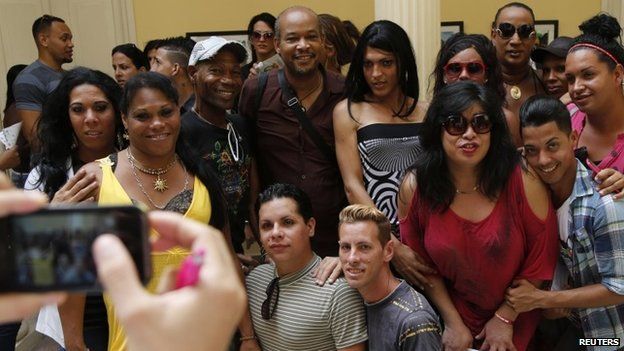
Members of Cuba's LGBT community pose for pictures - Havana, Cuba, Tuesday, May 5, 2015.
copyright Reuters - A law was passed in 2013 banning discrimination against sexuality - but not gender identity

Gay rights activists in Cuba will hold a mass wedding this weekend, in a country where gay marriage is still not legal.

The activists will be led by the daughter of President Raul Castro, Mariela, who is a leading gay and transgender rights campaigner.

The symbolic wedding will be part of Cuba's annual gay pride parade.

Ms Castro said she hoped the event could lead to further change in future.

In recent years, Cuba has taken steps towards integrating people from the lesbian, gay, bisexual and transgender (LGBT) community.

In 2010, two years after he stood down as president, Fidel Castro said he had been wrong to discriminate against gay people, who were sent to labour camps soon after the 1959 revolution.

In 2012, Adela Hernandez, who is biologically male but has lived as a woman since childhood, became the first LGBT person in Cuba to win a seat in office, after winning in municipal elections in central Cuba.

And in 2008, Cuba approved free sex-change operations to those who qualified.
Ms Castro, the head of the National Sex Education Centre and a member of Cuba's National Assembly, says her father supports same-sex marriage, but no legislation has yet been approved.

"We can't do a wedding, but we wanted to have a very modest celebration of love with some religious leaders," said Ms Castro,

"In the future we'll see what more we can do."

In December 2013, a new labour law was approved, outlawing discrimination based on sexual orientation.

But the law did not ban discrimination based on gender identity, and Ms Castro voted against it.

"There is a fear that this will tear Cuban society apart," Ms Castro said. "It will create cultural and ideological enrichment."

In its 2014 annual report, Freedom House, a US-based think-tank, criticised delays in implementing same-sex marriage in Cuba, and said the authorities "do not recognize the work of independent, grassroots LGBT rights groups".

ENDS

So now that the thawing of relations with Cuba and the US the gates have flung open and the island already seen as a novelty will only attract more curiosity seekers and the visitor is looking for a rugged experience and freedom from harassment (as happens here so much), not limited to a concrete jungle all inclusive Jamaica may be in for some stiff competition. 


Local hotels and small properties have been privately marketing to the growing LGBT market in the states I am told and in the aforementioned post it was mentioned but outward displays of affection is not a culturally palatable, the homo-negative and homophobic climate also plus the label of us being one of the most homophobic countries thanks to Time Magazine's article.

We need to learn and develop our own products and shed this fear and misunderstanding that is blocking so much potential.

Sadly the forward thinking is still not there from some in the business


also see:
Cuba And Caribbean Tourism (Gleaner 2015)

Sunday, March 25, 2012

Mariela Castro: “U.S government is concerned about LGBT movement in Cuba”

0 comments

Aday del Sol Reyes


Mariela Castro Espin, director of the National Center for Sex Education (CENESEX), grants an exclusive interview to CubaSi where she explains the educational work carried out by this institution.

Bachelor of Psychology-Pedagogy and Master of Sexuality, Mariela Castro is known internationally as a champion of the lesbian, gay, bisexual, transgender and intersex (LGBTI) rights in Cuba.

joined social networks and created an account on twitter, @CastroEspinM and the blog http://elblogdemarielacastro.blogspot.com in order to dismantle the prejudices that have been historically established and banish homophobia.

- You said “the Revolution has changed not only the lives of Cubans but also their sexuality” in a meeting with U.S. students last November. Why?

The Cuban Revolution meant not only the achievement of the long-awaited national sovereignty, but also a complex process of creating and implementing the project of justice, social equity and solidarity that has been built and defended during these 53 years.


This scenario led to the confrontation and dialogue between generations, cultural patterns, classes and social strata. Old paradigms of power based on domination and exploitation, inherited from Spanish colonial system and the U.S. neocolonialism, were questioned.

Undoubtedly, this process has generated radical and deep changes in our culture, our prejudices about sexuality, in the relation of domination of men over women, in the reconfiguration of courting, in sexual politics that privilege heterosexual relationships and exclude other forms of erotic and love relationships between human beings, which deny certain rights to those who do not meet these parameters.

Cuban cinematography and other artistic expressions have portrayed from a very creative point of view the vicissitudes of men and women for the development of these changes. For example, the overrated criteria of virginity and its contributing factor to marriage have been transformed. The same has happened with the imposition of a couple for the rest of our life, the sole responsibility of men as head of family, the loyalty standard of women and infidelity in men, the rejection of race relations, the myths of menstruation, the disqualification for single mothers and single women, women's rights, a disapproval to transgender people, gay and bisexual, among others.

- What is the status of the analysis of the bill calling for the legalization of gay marriage? Would the new Family Code recognize their property and personal rights besides allowing transsexuals’ change of identity?

At present, the draft bill proposal to amend the Family Code is being subjected to the criterion of specialists from the Ministry of Justice and professionals affiliated with the National Union of Jurists of Cuba. According to the Minister of Justice, its discussion in our Parliament is included in the legislative plan of 2012. I believe that the Party Conference may help to define a policy explicitly prohibiting discrimination on sexual orientation and gender identity and, in turn, help to dismantle the prejudices that hinder its adoption. The purpose of these proposals corresponds to the need to recognize and protect the rights of our population.

With regard to facilitating the legal identity change for transgender people without surgical intervention (as it happens now), we presented, through the Federation of Cuban Women, in 2008, a draft decree-law of Gender Identity to the President of the Committee on Constitutional and Legal Affairs of the People's National Assembly. There is no information on the development of this legislative initiative yet.

The proposal has an inclusive character for all transgender persons, identified by a specialized Commission of the Ministry of Public Health, since not all can be performed a surgery because of their health or personal decisions.

On occasion of your visit to Holland, you wrote on your twitter account @CastroEspinM “There exists in Cuba an explicit policy of care not only over prostitution but also over transactional sex, which is individualized”. Could you explain this?

Regarding prostitution topic, I start from the conviction that the autonomy over the body of all persons should be respected as a right. However, sex market has not disappeared thanks to the prevalence of forms of social organization based on patriarchal and class exploitation systems among human beings.

Some of its expressions are hard to make visible because the efforts of governments are focused on the most traditional and explicit interpretations, such as prostitution and human trafficking. These cases include transactional sex that refers to women and men who get some benefit from sex practice, which is not necessarily money. It has always existed, but it is only now that we talk about this phenomenon and in Latin America it is closely related to sex tourism, which has an own logic.

In Cuba, since 1959, the Federation of Cuban Women (FMC) led the attention to the problems generated by prostitution as a form of exploitation, mainly toward women, who were also underprivileged not only for their gender status, but for race and social class reasons as well.

It is known that there were more than 100,000 prostitutes in very precarious and humiliating conditions, who have expressed in public testimonies, how the Revolution changed their life, by benefiting them and favoring their prominence within a great liberating process which contributed to dignify them.

The work done by the Revolution to eradicate prostitution is a matter of national pride. The crisis that began in 1990 favored its reappearance as a social problem with new characteristics, especially linked to the development of international tourism and a consistent presence of customers who pay for sexual services and generate this market. Therefore, she praised the Swedish experience of penalising the customer, which has proved effective in the reduction of sexual exploitation.

-How many sex change operations have been performed in Cuba so far and in response to what requirements is the selection made?

There have been 15 sex reassignment surgeries. The first was carried out by Cuban specialists in 1988. But it was not until 2007 that this procedure was retaken by the Ministry of Public Health (MINSAP).

There exists a National Commission for Comprehensive Care of Transsexual People that has received 175 requests from trans population since 1979 and they are assisted according to internationally agreed parameters. As long as we divulge these services in the media, there will come more people who experience the conflict and do not know they can receive help.

Until now, trans people should go through a two-year follow-up period in which they are accompanied by specialists, along with a personalized hormone treatment, during the transition to the gender with which they identify themselves. At the end of this process, the Commission endorses the people who are eligible and are apt for the sex reassignment surgery (popularly known as “sex change”) and for the legal change of identify.

This surgery is not an aesthetic whim, but a procedure scientifically agreed on worldwide, which shows a considerable benefit for the welfare of trans people. The surgical procedure contributes to ease the permanent anguish that these people have lived since their early childhood, as a result of the prejudices that lead to incomprehension and discrimination.

- What’s your opinion on the confirmation by WikiLeaks on the financing ($300. 000) the U.S government has established for the subversion of the LGBT project in Cuba?

In the first place, this explicit reaction on behalf of the U.S. government demonstrates that the work carried out in Cuba for the rights of the lesbians, gays, bisexual, transsexual, and intersex (LGBTI) worries and occupies them, in time and resources. Why? Because it shows the Cuban government's political will to face homophobia and transphobia as forms of discrimination, which are not consistent with the emancipating project defended by the Cuban revolution.

What we are doing tears apart the worn-out media campaigns to discredit the spirituality of the revolutionary project and makes evident the resources of North American taxpayers dedicated to lie, slander, demonize, and collapse this changing experience and its leaders.

They have set their efforts in giving privilege to a few unauthentic voices, repeating them in traditional media, blogs and social networks that follow a spiteful misleading program with a pre-established script.

Strong evidences have been presented on the orders received by these mercenaries, on behalf of the U.S. Interest Section in Havana. Some of these evidences were published by WikiLeaks.

Many people who have been eye witness of the facts and later read the news which have been broadly spread can appreciate the gross way of manipulating the international public opinion in largely influential press media like the Spanish CNN, El País, Der Spiegel, Radio Nederland, among others.

- Several steps have been taken in Cuba to promote the respect to the free and responsible sexual orientation and gender identity, however, these are not enough yet. In your opinion which is the path to follow to get to the hearts of all Cubans and banish, once and for all, the homophobia in our country.

The first steps were taken by the Federation of Cuban Women (FMC), with the creation of the National Group of Work on Sexual Education in year 1972, forerunner of CENESEX.

The FMC also propitiated a public debate on these topics. A landmark moment was the publication of the book "Man and Woman in Intimacy" (Sigfred Schnabel, 1979), in which a scientific voice argued, for the first time in Cuba, why homosexuality is not considered a disease.

Many homosexual people have told me the benefits these messages meant to them, against stigmatizing burden society imposes on them.

Exactly after assessing the actions we have carried out are not enough, in year 2007 we joined the initiative of the French activist Georges Tin of celebrating the International Day against Homophobia on May 17, because in that date of 1990 the World Health Organization (WHO) eliminated homosexuality from its manual of classification of mental illnesses.

From this experience in 2008 we begin to work with an educational strategy, with the support of the media, for the respect to the free and responsible sexual orientation and gender identity.

These activities have been supported by several state institutions and organizations of the civil society, with the support of the Ideological Department of the Central Committee of the Communist Party of Cuba, and they have contributed to create a LGBTIH movement, with the peculiarity of including heterosexual people who actively participate in this cause.

Why do we choose an educational and communicative strategy? 


Because it’s about a deep process of cultural transformation, of contributing with analysis elements to dismantle the prejudices that have been established historically to dominate people, their sexualities and their bodies. The change in the social awareness is really complex and takes a lot of time, but there must be a political will to enable the change, otherwise we would be repeating the ways of thinking of the exploitative societies before us.

- How much of Vilma is there in Mariela?

The permanent opposition to all expressions of social injustice. The commitment with the revolutionary process that has been generated since the first emancipating reactions of our people which became mature in the struggle for the definitive independence of the Cuban nation. The sincerity, the dissent, the humility, and the persistency.

Cubasi Translation Staff

Thursday, September 8, 2011

Prejudices prevent recognition of LGBT rights, ..... Mariela Castro

0 comments


Prejudices prevent recognition of LGBT rights, Mariela Castro tells Fernando Ravsberg in this interview with Havana Times.

Mariela Castro is the director of the National Center for Sex Education (CENESEX), from where she along with hundreds of activists struggle to ensure respect for the rights of Cuba’s community of lesbians, gays, bisexuals and transsexuals (LGBTs).
The daughter of the president of Cuba, Raul Castro, she has achieved important advances in making homophobia socially visible, authorizing free sex-change operations and bringing the community out of its marginalization by organizing its members in the defense of their rights.

This past weekend, activities centered around CENESEX during the observance of World Sexual Health Day, where books and audiovisual materials were presented, as well as workshops organized for young rockeros (rock fans), punks and emos – whose place in society is being questioned by part of society.
Taking advantage of the occasion, Mariela granted us an exclusive interview.

Q: When did you begin work in the defense of the rights of the LGBT community?

A: Starting in 2000 we begin working more directly to give visibility to sexual rights, especially those of LGBT people, which had been greatly hampered by the prejudices of Cuban society.

Q: How much progress has been made since then?

A: Our ties with institutions have strengthened our position in society for bringing to light the issues we’re dealing with. This has served in training more professionals and strengthening the network of activists who work with CENESEX.
The dialogue that we’ve achieved with the Ideological Department of the Communist Party has been very important because, though at the beginning they were quite alarmed, now they’re our allies.

Q: But all those relationships haven’t served in getting the National Assembly to pass the Family Code, which is legislation that includes the rights of the LGBT community …

A: These obstacles demonstrate that the prejudices are even stronger than the institutions we hope to develop.
The Family Code is already edited but we know that in the Ministry of Justice is re-editing it in an attempt to change it — based on their own prejudices — to make it different from what we’ve proposed. But if what they approve doesn’t respond to the rights of LGBT people, we won’t accept it.
We regret that they haven’t included us in that debate, because they’re creating a puzzle out of what we proposed and their prejudices.

Q: How might this affect the alliance between the Catholic Church and the Cuban government?

A: I believe there should be alliances between all institutions in a society. The Catholic Church has been consistent in outlining its disagreement with what we’re doing, but it isn’t waging war against us. I don’t feel that they’re the obstacle.

Q: Your dad has spoken about discrimination against blacks, women, religious believers and even the youth. 
How is it that he hasn’t gotten to the point of mentioning the LGBT community?

A: Because evidently there are still many people close to him who are homophobic, so for him to achieve consensus is not going to be so easy. He’s introducing the issue, though he hasn’t been able to throw it open all at once. According to what delegates who attended the 6th Party Congress told me, he spoke about the issue and said that it was now necessary to make decisions in this respect and to overcome those problems. That gave me a great deal trust and faith. I’m hoping this issue will be raised in the upcoming party conference [scheduled for January].

Q: What are the main obstacles?

A: The obstacles exist because prejudices dominate institutional decisions here, something that can change beginning with this general process of change that Cuba is going through. To the degree in that it continues to be participatory, like it began, that will facilitate this issue entering into the wheels of decision making.

Q: Many people complain that it’s a waste of Public Health resources to provide free sex-change operations.

A: Here in Cuba, we don’t lack resources for life-or-death operations; if we don’t have them we go look for them. That was a position championed by Fidel and one which fortunately has remained. Also, sex-change operations are not so expensive and they’re not performed on mere whims.
This is a question of law, and if public health is a right of everyone then people who are transsexual cannot be excluded.

Q: I remember hearing many of those same concerns of yours reflected in your mother’s (1) thinking?

A: Her work at the head of the Federation of Cuban Women gave her the opportunity to understand other problems, like those that stigmatize the LGBT community. Even in the era of UMAP (2) and the Quinquenio Gris (the Gray Five Year Period) (3), she was one of the voices that opposed those processes.

When the Family Code approved in 1974 or ’75 was presented, my mother proposed that marriage be considered “a union between two people,” so that homosexual couples wouldn’t have any problems.
My dad also conveyed much to me. Although people don’t know it, he was not in favor of many of these things (repression against gays) but he had to move within the consensus of a very complex circle.

Thanks to my mom, he didn’t agree. He came from a patriarchal and homophobic culture but he recognized that it could change thanks to her influence.

For the original report go to http://www.havanatimes.org/?p=50300

Tuesday, August 16, 2011

Havana Times’ Dmitri Preite Samsonov interviews blogger and activist Yasmin Silvia Portales Machado

0 comments


The readers of Havana Times probably know Yasmin Portales from her recent initiative in support of the LGBTI* community in Cuba: “The Rainbow Project” (Spanish: Proyecto Arcoiris). But the fact is that Yasmin a multifaceted activist and blogger, a defender of freedom of speech and of women’s rights and “peripheralized” groups (excuse me, a better epithet didn’t come to mind) – referring to people such as those of African descent or members of the LGBTI community.

A social activist who defines herself as a feminist and a Marxist, she signs her e-mails with a phrase by Carlo Frabetti: “Engels couldn’t have said it clearer: the first form of exploitation, the basis of all others, was the exploitation of woman by man; but not even Marx listened to him.”

HT: Yasmin, you begin one of your last posts with the brief and definitive sentence: “I’ve reached the saturation point. I have political rights, I have civic duties, I have a problem with the legal system of this country.” How do you generally assess the current situation in Cuba, particularly around the issue of people who are LGBTI?

YASMIN SILVIA: I can’t tell you how I “generally assess the current situation in Cuba,” because I don’t see it. Our “friends” of the Communist Party of the Soviet Union accustomed us to a lack of transparency, and our enemies from Washington prevent me/us from rightly knowing where we’re heading. For me this moment is, along with everything else, pregnant with hope. The president’s speeches refer to battles in his (our) hidden war with the bureaucracy and that it’s necessary to spell things out “slowly and carefully” to fix the government. But honestly, I don’t know where that combat is taking place or who’s winning. But judging by the newspapers Trabajadores from Bayamo, and Juventud Rebelde in the column “Acuse de Recibo,” the bureaucrats are racking up points.
In short, I don’t know where we’re going; I only know that I can’t stay still, because this is my government too, right?
In the specific case of politics among LGBTI people, diversity is flourishing, which is something good. In this way we’re struggling to learn how to respect ourselves in our sexual and political diversity. We are learning to debate with solid arguments in the face of a social norm that discriminates against us, while internally the LGBTI community has barely begun to think of itself as members of a citizenry with full and equal rights.

HT: How is all of that related to the “Project Rainbow” that you’ve just started? What do you think can be done?

YP: The Project Rainbow is precisely that: an initiative to unite LGBTI people around the idea that we should renovate resources so that our demands for recognition and protection before the Cuban government are heard. We are activists who, with differing educations and life experiences, have wound up assuming anti-capitalist, anti-patriarchal, anti-discriminatory and environmentalist positions. From that political profile we are assuming dialogue with the government and civil society, and that will mark the way in which we are organized, act and propose alternatives.
Basing oneself on the exercise of critical reading, I believe that one can do a lot to recover historical memory and spread understanding of the current laws that establish our rights. Moreover, such readings can promote solidary action in diverse types of professional networks. All these fields of action are open. They’re natural spaces for the work of fraternal community organizations. In this sense of “scope,” Project Rainbow is only a small droplet in a potentially fertile sea of diverse associations. It’s not only an initiative of people with the desire to act; it’s also an invitation to action from distinct socio-cultural perspectives.

HT: How does this initiative differ from other ones? For example, those sponsored by CENESEX, the government organization that works around all issues related to sexuality; or the recently begun Observatorio LGBT de Cuba, whose logic seems to be in tune with that promoted by some anti-government opposition groups.

YP: I said it synthetically in a blog post that touched all this off, but I’ll try to explain it better: HxD, Oremi, the TransCuba project (I’ve just discovered that they have a blog, great!) belong to CENESEX. They’re part of the strategy of social networks that the institution has been promoting for almost a year to increase the capacity of its activists to organize themselves and to have an impact on the LGBTI community. Although it would be interesting to find out how much CENESEX has been energized based on this relative autonomy of its activists, none of the three groups are independent. Let’s say that they’re in line with the government (which isn’t good or bad per se), and as such it’s fair that they respect the policies of CENESEX, the tacit and/or explicit limits that the center maintains as a state institution.

On the other side is the “Cuban Observatory for the Rights of the LGBT Community” (a long name, right?). I agree with the blogger “Paquito el de Cuba” in seeing that the problem isn’t that they promoted a very well publicized “Gay Pride Parade” and could convince just nine marchers to participate (because with few people major changes have occurred). The problem is the way Leannes Imbert and his colleague Ignacio Estrada query CENESEX, assuming the position of a frontal attack and negating its merits, which has nothing to do with my idea of an appropriate debate on the means and objectives for struggling against discrimination.

Outside of that, there’s no known concrete action proposal by the Cuban Observatory for the Rights of the LGBT Community in which they’re contributing something new. There’s nothing that legitimizes them as true activists with well-conceived actions.

HT: Speaking of CENESEX (which operates under the Ministry of Health, or MINSAP), do you think that it’s legitimate to treat the issue of LGBTIs and the issue of gender generally as a matter of “public health”? Do you have any alternative ideas in this respect?

YP: For me it’s not legitimate, in principle, that issues of discrimination on the basis of one’s sexual orientation or issues of gender identity are in the hands of a health agency, yet in its field CENESEX has won the right to express itself and make proposals. Here’s a little history:
The way in which CENESEX arose within the framework of MINSAP is related to its origin, which was the Commission for Attention to Transsexual People, and which was around in the 1970s. Currently, part of its work continues being public health-related because it’s true that people who are transsexual and intersexual need support and accompaniment in dealing with the health care system and because medical consultations for people or couples with sexual dysfunctions are the responsibility of MINSAP. I have no doubt that sexual and reproductive health are public health concerns.

However, the Center has gone from arguing over the relevancy of overcoming certain pseudoscientific visions about sexuality in the Cuban health care system to sparking social debate concerning the social and political rights of the victims of hetero-normality. It’s an enormous qualitative leap that it has assumed because no other institution in the country has been able to take on such a challenge. But that no one else could, or wanted to, assume the problem, doesn’t mean that CENESEX is the most suitable to address it. On the other hand, it does indicate that they have courage, ethics and a sense of duty. Those are merits that no one can deny the CENESEX collective.
The fact is that Cuba — its legal, institutional and political part — isn’t designed for the systematic exercise of social criticism from the position in which we LGBTI people find ourselves, the exercise we can label as “politics of identities.” Our institutional designs have to group you as a part of a government-dependent organization or atomize you to the extreme, because in the official logic there’s only one identity: the national one. So, without transforming the model that governs the policies of Cuban associations, we couldn’t break out of the CENESEX-MINSAP orbit relating to matters of hetero-normality, just as we were unable to escape the CITMA (Ministry of Science, Technology and Environment) – MINCULT (Ministry of Culture) orbit regarding race-related issues.
That is my proposal, which admits that people not only link up due to professional, spiritual or political, reasons, but also because they’re united as victims of discrimination, and that’s a reason to come together. It’s a legitimate method for emancipating ourselves.

HT: Yasmin, you identify yourself in your e-mails as a “Marxist, feminist blogger.” What does that triple identity mean to you? Is it perhaps a triple project of resistance?

YP: This is the first time I’ve stopped to look at it like that! Resistance? Yes – that’s one way to put it. When I conceived of it, it was more a matter of how to explain it to people that certain matters shouldn’t be played with in your presence. To me, one doesn’t play around with money, the class struggle, patriarchy or freedom of speech. You can talk but you don’t play. These are words that came to me years apart.
To believe in Marxism at the end of ‘90s, when I entered the university, was an “antiquated” position, unless you planned to pursue a political career. I began very successfully as a student leader, but I realized over time that I didn’t want to be a “leader,” but a “Marxist intellectual.” I was in an intense “Young Pioneer” phase, stuck in “We will be like Che” and without the capacity for negotiation.
Being a feminist in Cuba has never been “politically correct.” I took offense when Julio César Guanche called me that in 2002. To calm me down he told me, “You’re a feminist, you just don’t know it.” Only after reading certain writings, seldom recommended to marriageable young ladies sheltered in their homes, I had to agree with him. Up until then I didn’t know I was actually a feminist.
To be a blogger — defending my/the right to express personal reflections in a public space — generates a lack of understanding in a culture whose informational paradigm is based on a monopoly. Since 2005 I haven’t stopped running into people who ask me “So you put your thoughts there for everybody to read them?” To which I respond: “Of course. Isn’t that my right?”
This is connected with resistance, isn’t it?

HT: By the way, in your opinion, what’s the limitation of Cuban feminism?

YP: Cuban feminism? That’s the first news I’ve heard it exists. For me there are Cuban feminists and there’s a women’s movement in Cuba, but as for a specific line of explanation concerning the relations between the genders from a specific sociocultural perspective (like black feminism, Islamic feminism, one that’s different or radical feminism), it doesn’t seem that we have something like this on the island. Maybe you should adjust the question.

HT: Ok – what are the limitations of Cuban feminists?

YP: The logic of feminism is so revolutionary that it doesn’t fit into the structure of the Federation of Cuban Women. Like anti-racism and LGBTI activism, it remains in institutional limbo. And in Cuba, this is equal to political limbo and permanent suspicion. That’s why, though there’s a great team of women and men with excellent preparation in matters of gender whose actions barely go beyond the limits of academia. These people could do so much in social politics, public debates or managerial strategies!

HT: At the 2011 Social Forum of the Critical Observatory, you introduced the notion of a “personal political agenda.” What does this involve? Can there exist such “agendas” within the customary calls for revolutionary unity in Cuba? Also, I’d like you to talk a little about what your own participation in the Critical Observatory Network has meant to you.

YP: Tell me something, is that phrase going to continue sticking with me for long? Frankly, I’d hoped they would have keyed in on other parts of the presentation.
You have to realize that the phrase was used in a context of confrontation. I explained the confrontation between a paradigm of control over pre-Internet knowledge and the possibilities for exchanging experiences as well as the establishment of resistance with the resources of the Internet.
“Personal political agendas” are not things that emerged with the web; this refers to peoples’ identities, how much they’re willing to invest — materially, spiritually and temporally — in their dreams for public space. What the network facilitates is the search for peers who may help you in involving with issues such as changing the educational system, organizing an initiative around non-violence or repairing the neighborhood cultural center.
Of course such a thing can exist within a revolutionary unity; we’re people, not objects, therefore we have goals, opinions and perspectives. All of that makes up people’s “personal political agendas,” which is summed up through a process of constant negotiation with whoever accompanies us on the path to action. To me, a person without a “personal political agenda” has stopped dreaming.
That’s what I like about the Critical Observatory Network: it brings together people who dream. My experience with those who make it up, people from diverse fields of knowledge, is that they don’t give up trying to transform ways of doing things or the spirit of those who do. With more or less sophisticated languages, joining the Network implies a daily commitment from people to work for emancipation, transcending the cultural logic of the late capitalism in which we live and outlining of a new paradigm – one that I call communist.
I know that everything doesn’t work as well as I would like. There are external pressures, the social logic in which we live, as well as internal contradictions in which we members all fall into as we attempt to act, which slows down our advance. However the Critical Observatory Network isn’t above me, it’s within. That’s why it suits me.

HT: In that same Critical Observatory Social Forum, a brief video was filmed where you argue with great emphasis and emotion that “the revolution has to be taken to its final consequences.” What is a/the revolution for you? Is it commitment to a historic leadership, a government, a tradition of struggle? – or does it mean not giving into enemies “not even a little”? Or is it something more than that?

YP: Can you copy the video for me? The problem is that I don’t have access to YouTube…

HT: Me neither, Yasmin. We don’t have the bandwidth for that. But there’s a copy around here on a pin drive…

YP: Well, seriously: What is a Revolution? You saw me looking like Rosa Luxemburg or Alexandra Kollontai? How do I define revolution? More or less, I know that it’s a process, a sociopolitical one, that always brings with it a little bit of blood and a few decapitations – to make it clear that we’re talking about something serious. The idea is to change the whole economic system in a short period of time to satisfy the needs of a class, which up until then has been deprived but wants its part of the pie…its part of the means of production.
That’s how it is, revolutions are forward movement. The model can only call itself that if the class that takes power is wider and more democratic than the one beheaded. That’s what guillotines and firing squads are for. Revolution has to succeed at implanting a new logic, one that’s more flexible and more efficient in its mechanisms of satisfying the needs of society as a whole. The revolution has to be able to explain the world and justify itself in an almost coherent way. Do you like that?
Therefore, revolution involves the commitment to ideas, with models of the country and the society that you try to concretize. Commitment is not to a group of people, no matter how much you respect them, nor to the government’s model, because it can become obsolete.
Commitment is to a tradition of struggle for independence, sovereignty, the emancipation of people and everyone’s access to what humanity’s knowledge can offer so as to make life full – physical and mentally. The commitment is to social justice, not personal comfort.
Of course, what I’m describing is a process marked by the violence of classist confrontation. That’s why someone once said that we will leave prehistory behind when we supersede capitalism. There’s an enemy with as many faces as illusions of domination — capitalism is the first economic system that succeeded in making autophagy a virtue — and not giving it “even a little bit,” is complicated. This implies making ideas essential but practice very reflective. One of the few things that I’m sure of is that to stop in the process of forging change is to give them the advantage.

HT: How are you able to reconcile motherhood, marriage, family life and economic difficulties with that agenda? And, well, what’s the idea of family that you profess?

YP: That’s like asking the centipede which leg it uses first to dance. Every day, Roge (my husband, Rogelio) and I try to coordinate our work schedules with our son’s care. The rest we come up with as we go along.
What’s my idea of family? It’s supposed that the family is a genetic condition, but death, poverty or extreme intolerance can force you to have to build your family from scratch. In general terms, I believe that a family consists of those people with whom you have such an intense positive sentimental bond that you prefer to have them close to you with certain regularity. They are people who you know and accept as they are – even above ideology. They are people for whom you would run risks and who you consider when you make plans that affect life, such as bringing about a revolution or organizing a girl’s “Sweet ‘Fifteen’” party at the Hotel Nacional.

HT: Could you tell me about your experience as a blogger…about the Bloggers Cuba collective? What’s the profile of your blog and why does it have such an unusual name?

YP: I became a blogger in September 2005 because I wanted to have a place online for my demons, for the dirty stories that I compulsively wrote but didn’t have anywhere to publish. Gradually an explicit political practice emerged in the content of those posts, because just being a blogger is already a political gesture. Back then it was rather a solitary matter. I came to Bloggers Cuba through Boris Leonardo (who blogs at “Los rumores”), and starting from there the experience became rich thanks to an internal discussion about what it is to be a blogger in Cuba, and because I collided with comments and what other people “expected” to be written from Cuba. Anyway, I tried to function in a way so that the commentators wouldn’t put the screws on, because they accused me of being a “state security agent” and other nonsense.
As for the profile of my blog, to begin with, there are three of them.
I started up Palabras robadas (“Stolen words”) in September 2005. It’s dedicated to “fanfiction.” It’s basically homosexual erotic literature, but there’s something political in it because in those stories I often begin to speculate about what is a relationship between a couple, what is family and what is power or obsessions, all these being topics of feminist thinking, as you can imagine.
In 2006 Bubusopia emerged. At first it was a blog for gathering news, but later I convinced Roge to fire off his political diatribes in posts. At the moment I’m publishing very little on that site.
It wasn’t until 2007 that the third site arose. It was first called himself Solo mis palabras (Only My Words), until one day I thought it sounded like a teenager’s diary name, so I looked for something abstract. The title “En 2310 y 8225” refers to the geographical coordinates of our house. It’s a personal and reflective blog of my interests, opinions, sentimental jolts and academic readings. If we were to label it, it will be “Marxist and feminist,” like me.

HT: There’s talk in Cuba of (self-described) “revolutionary bloggers” and “alternative bloggers.” Similarly, there is “a merciless digital war” being waged, at least according to the sides in that conflict: the alternative and the official sides – or, inversely, between good Cubans and the enemy’s mercenaries. On which side of that dispute do you place yourself?

YP: On neither, of course. This war is invented and maintained by people who live off of war, whose goal is war, not peace. That’s why they’re determined to move Cuban blogs under the same dualist premise that marks our politics, along with the rhetoric of violence and threats they use in other older fields. These people choose to forget that the nature of blogs is diverse, like the people who generate them.

HT: You participated actively in the controversy unleased as a result of Ted Henken’s research on the Cuban blogsphere, which also involved Havana Times. Why such an emotional defense of an initiative that you don’t belong to? What are your desires for the Cuban blogosphere and for each of the groups that comprise it (according to Ted Henken)?

YP: You see, it’s like in the poem by Bertolt Brecht that ends, “And then…they came for me…And by that time there was no one left to speak up.” As part of Bloggers Cuba (BC), I share with HT the vocation to engage in civic journalism from platforms open to the public’s involvement, with the objective of diversifying the vision that we have of our society inside and outside of Cuba.
The people in the previous response (those on one side or the other living for war), they don’t want these alternatives. They know we’re putting their hegemony in danger. So defending HT from persecution and attacks on its credibility is a minimum common sense reaction. We are close as bloggers, claiming the right of the people with HT to exist – as long as it’s not proven that they’re agents of the CIA effectively involved in subversion acts against Cuba. This support is to defend the right of all of authentic civil society to exist, and that includes me. Did you think I did it as a do gooder?
Following this logic, the only things I want for the Cuban blogosphere is for its bandwidth to increase, the prices of spare parts to go down, the migration to open-source software to be generalized and that we learn how to respect bloggers’ and commentators’ opinions — sexual, political, economic and aesthetic…in short, their ideologies.
In terms of Ted Henken’s research, I’ve already solved that problem: I’ve done my own.
To me, the Cuban blogosphere has four parts: exiled, “insilio” (“in-xiled”), official and resistance.
The “exiled” are those who migrated and work against the government, therefore they extend their objectives and belligerency to the blogosphere.
I owe Isbel Alba Duarte for the term “insilio” (“in-xiled”), which refers to the blogs of those who reside in Cuba and oppose the government.
The blogs in exile and in insilio can be contrasted to the “Bloggers of the Revolution,” which can be called “official” for their hard line in defense of the identification of Cuba with the current government.
I’m adding to these terms the category of “in resistance,” referring to the small niche of people who work inside and outside of Cuba attempting to unmask the previous dualist tradition. This category operates for emigrants and residents, and it is expressed above all in thematic choices and focus. For more details, see my report: “Voces femeninas en la blogosfera cubana. ¿Cambió algo más que el soporte?” (Female voices in the Cuban blogosphere: Did more than just support change?)”, presented in June at the Universidad de Madeira.

HT: What will be the next actions of Project Rainbow and of Yasmin Silvia as a blogger?

YP: Project Rainbow is consolidating. We’ve already had a working meeting and now we have to come to a consensus on the founding document. Also, we’re thinking about initiatives to foment international and national LGBTI historical memory in Cuba. This is something we consider basic for our long term objectives. We’re in agreement that a community without consciousness of itself cannot act autonomously, nor can it affirm or deny its representatives. To be legitimate — politically speaking — we therefore need a community that is aware.
As a blogger, then…you know that even when I was little they told me that I was always quarrelsome. The thing is that I can’t just turn the other cheek, and the blog is one way for me to strike back.
For the original report go to http://www.havanatimes.org/?p=48707
Related Posts with Thumbnails

AddThis

Podcasts You may have missed or want to re-listen


A look at the fear of the feminine (Effemophobia) by Jamaican standards & how it drives the homo-negative perceptions/homophobia in Jamaican culture/national psyche.


and


After catching midway a radio discussion on the subject of Jamaica being labelled as homophobic I did a quick look at the long held belief in Jamaica by anti gay advocates, sections of media and homophobes that several murders of alleged gay victims are in fact 'crimes of passion' or have jealousy as their motives but it is not as simple or generalized as that.

Listen without prejudice to this and other podcasts on one of my Soundcloud channels

More uploads


Aphrodite’s PRIDE JA tackles gender identity, transgender misconceptions .....


Nationwide New Network, NNN devoted some forty five minutes of prime time yesterday evening to discuss the issue and help listeners to at least begin to process some of the information coming from the most public declaration exercise as done by Jenner. Guests on the show were Dr Karen Carpenter Board Certified Clinical Sexologist and Psychologist, ‘Satiba’ from Aphrodite’s P.R.I.D.E Jamaica of which I am affiliated and Lecturer (Sociologist) and host of Every Woman on the station Georgette Crawford Williams (sister of PNP member of parliament Damian Crawford); one of the first questions thrown at Satiba by host Cliff Hughes was why has Jenna waited so long at 65 years old to make such a life changing decision?

Satiba responded that many transwomen have to hide their true identity in life .... given her life when she was younger she was a star athlete she would have been under tremendous precious to stay in from the expectations by the public and her team etc, also owing to the fact that she had a family as a man with children one may not want to upset the flow at that time until the kids are old enough. There is a lot of burden of guilt that some persons carry in weighing the decisions of coming out or transitioning so suppression of one’s true self is the modus operandi.

Dr Carpenter cautioned after a heated exchange:

“We really must remember as professionals we must stay in our lane I will never pronounce as a Sociologist cause I am not a Sociologist ............When we have an opportunity to speak publicly we must be careful of what we say unless it is extremely well informed......”


Aphrodite's P.R.I.D.E Jamaica, APJ launched their website


Aphrodite's P.R.I.D.E Jamaica, APJ launched their website on December 1 2015 on World AIDS Day where they hosted a docu-film and after discussions on the film Human Vol 1


audience members interacting during a break in the event


film in progress

visit the new APJ website HERE

See posts on APJ's work: HERE (newer entries will appear first so scroll to see older ones)

Dr Shelly Ann Weeks on Homophobia - What are we afraid of?


Former host of Dr Sexy Live on Nationwide radio and Sexologist tackles in a simplistic but to the point style homophobia and asks the poignant question of the age, What really are we as a nation afraid of?


It seems like homosexuality is on everyone's tongue. From articles in the newspapers to countless news stories and commentaries, it seems like everyone is talking about the gays. Since Jamaica identifies as a Christian nation, the obvious thought about homosexuality is that it is wrong but only male homosexuality seems to influence the more passionate responses. It seems we are more open to accepting lesbianism but gay men are greeted with much disapproval.

Dancehall has certainly been very clear where it stands when it comes to this issue with various songs voicing clear condemnation of this lifestyle. Currently, quite a few artistes are facing continuous protests because of their anti-gay lyrics. Even the law makers are involved in the gayness as there have been several calls for the repeal of the buggery law. Recently Parliament announced plans to review the Sexual Offences Act which, I am sure, will no doubt address homosexuality.

Jamaica has been described as a homophobic nation. The question I want to ask is: What are we afraid of? There are usually many reasons why homosexuality is such a pain in the a@. Here are some of the more popular arguments MORE HERE

also see:
Dr Shelly Ann Weeks on Gender Identity & Sexual Orientation


Sexuality - What is yours?

Promised conscience vote was a fluke from the PNP ........


SO WE WERE DUPED EH? - the suggestion of a conscience vote on the buggery law as espoused by Prime Minister (then opposition leader) in the 2011 leadership debate preceding the last national elections was a dangling carrot for a dumb donkey to follow.

Many advocates and individuals interpreted Mrs Simpson Miller's pronouncements as a promise or a commitment to repeal or at least look at the archaic buggery law but I and a few others who spoke openly dismissed it all from day one as nothing more than hot air especially soon after in February member of parliament Damian Crawford poured cold water on the suggestion/promise and said it was not a priority as that time. and who seems to always open his mouth these days and revealing his thoughts that sometimes go against the administration's path.

I knew from then that as existed before even under the previous PM P. J. Patterson (often thought to be gay by the public) also danced around the issue as this could mean votes and loss of political power. Mrs Simpson Miller in the meantime was awarded a political consultants' democracy medal as their conference concludes in Antigua.


War of words between pro & anti gay activists on HIV matters .......... what hypocrisy is this?


War of words between pro & anti gay activists on HIV matters .......... what hypocrisy is this?

A war of words has ensued between gay lawyer (AIDSFREEWORLD) Maurice Tomlinson and anti gay activist Dr Wayne West (supposed in-laws of sorts) as both accuse each other of lying or being dishonest, when deception has been neatly employed every now and again by all concerned, here is the post from Dr West's blog

This is laughable to me in a sense as both gentleman have broken the ethical lines of advocacy respectively repeatedly especially on HIV/AIDS and on legal matters concerning LGBTQ issues

The evidence is overwhelming readers/listeners, you decide.


Fast forward 2015 and the exchanges continue in a post from Dr Wayne West: Maurice Tomlinson misrepresents my position on his face book page and Blog 76Crimes

Tomlinson's post originally was:


Urgent Need to discuss sex & sexuality II


Following a cowardly decision by the Minister(try) of Education to withdraw an all important Health Family Life, HFLE Manual on sex and sexuality

I examine the possible reasons why we have the homo-negative challenges on the backdrop of a missing multi-generational understanding of sexuality and the focus on sexual reproductive activity in the curriculum.

also see:

and


Calls for Tourism Boycotts are Nonsensical at This Time


(2014 protests New York)

Calling for boycotts by overseas based Jamaican advocates who for the most part are not in touch with our present realities in a real way and do not understand the implications of such calls can only seek to make matters worse than assisting in the struggle, we must learn from, the present economic climate of austerity & tense calm makes it even more sensible that persons be cautious, will these groups assist when there is fallout?, previous experiences from such calls made in 2008 and 2009 and the near diplomatic nightmare that missed us; especially owing to the fact that many of the victims used in the public advocacy of violence were not actual homophobic cases which just makes the ethics of advocacy far less credible than it ought to be.

See more explained HERE from a previous post following the Queen Ifrica matter and how it was mishandled

Newstalk 93FM's Issues On Fire: Polygamy Should Be Legalized In Jamaica 08.04.14


debate by hosts and UWI students on the weekly program Issues on Fire on legalizing polygamy with Jamaica's multiple partner cultural norms this debate is timely.

Also with recent public discourse on polyamorous relationships, threesomes (FAME FM Uncensored) and on social.

Some Popular Posts

Are you ready to fight for gay rights and freedoms?? (multiple answers are allowed)

Did U Find This Blog Informative???

Blog Roll

What do you think is the most important area of HIV treatment research today?

Do you think Lesbians could use their tolerance advantage to help push for gay rights in Jamaica??

Violence & venom force gay Jamaicans to hide


a 2009 Word focus report where the history of the major explosion of homeless MSM occurred and references to the party DVD that was leaked to the bootleg market which exposed many unsuspecting patrons to the public (3:59), also the caustic remarks made by former member of Parliament in the then JLP administration.

The agencies at the time were also highlighted and the homo negative and homophobic violence met by ordinary Jamaican same gender loving men.

The late founder of the CVC, former ED of JASL and JFLAG Dr. Robert Carr was also interviewed.

At 4:42 that MSM was still homeless to 2012 but has managed to eek out a living but being ever so cautious as his face is recognizable from the exposed party DVD, he has been slowly making his way to recovery despite the very slow pace.

Thanks for your Donations

Hello readers,

Thank you for your donations via Paypal in helping to keep this blog going, my limited frontline community work, temporary shelter assistance at my home and related costs. Please continue to support me and my allies in this venture that has now become a full time activity. When I first started blogging in late 2007 it was just as a pass time to highlight GLBTQ issues in Jamaica under then JFLAG's blogspot page but now clearly there is a need for more forumatic activity which I want to continue to play my part while raising more real life issues pertinent to us.

Donations presently are accepted via Paypal where buttons are placed at points on this blog(immediately below, GLBTQJA (Blogspot), GLBTQJA (Wordpress) and the Gay Jamaica Watch's blog as well. If you wish to send donations otherwise please contact: glbtqjamaica@live.com or lgbtevent@gmail.com


Activities & Plans: ongoing and future
  • Work with other Non Governmental organizations old and new towards similar focus and objectives

  • To find common ground on issues affecting GLBTQ and straight friendly persons in Jamaica towards tolerance and harmony

  • Exposing homophobic activities and suggesting corrective solutions

  • Continuing discussion on issues affecting GLBTQ people in Jamaica and elsewhere

  • Welcoming, examining and implementing suggestions and ideas from you the viewing public

  • Present issues on HIV/AIDS related matters in a timely and accurate manner

  • Assist where possible victims of homophobic violence and abuse financially, temporary shelter(my home) and otherwise

  • Track human rights issues in general with a view to support for ALL
Thanks again for your support.

Tel: 1-876-841-2923


Peace

Information & Disclaimer


Individuals who are mentioned or whose photographs appear on this site are not necessarily Homosexual, HIV positive or have AIDS.

This blog contains pictures that may be disturbing. We have taken the liberty to present these images as evidence of the numerous accounts of homophobic violence meted out to alleged gays in Jamaica.

Faces and names withheld for the victims' protection.

This blog not only watches and covers LGBTQ issues in Jamaica and elsewhere but also general human rights and current affairs where applicable.

This blog contains HIV prevention messages that may not be appropriate for all audiences.

If you are not seeking such information or may be offended by such materials, please view labels, post list or exit.

Since HIV infection is spread primarily through sexual practices or by sharing needles, prevention messages and programs may address these topics.

This blog is not designed to provide medical care, if you are ill, please seek medical advice from a licensed practitioner

Thanks so much for your kind donations and thoughts.

As for some posts, they contain enclosure links to articles, blogs and or sites for your perusal, use the snapshot feature to preview by pointing the cursor at the item(s) of interest. Such item(s) have a small white dialogue box icon appearing to their top right hand side.

Recent Homophobic Cases

CLICK HERE for related posts/labels and HERE from the gayjamaicawatch's BLOG containing information I am aware of. If you know of any such reports or incidents please contact lgbtevent@gmail.com or call 1-876-841-2923

Peace to you and be safe out there.

Love.


What to do if you are attacked (News You Can Use)


First, be calm: Do not panic; it may be very difficult to maintain composure if attacked but this is important.

Try to reason with the attacker: Establish communication with the person. This takes a lot of courage. However, a conversation may change the intention of an attacker.

Do not try anything foolish: If you know outmaneuvering the attacker is impossible, do not try it.

Do not appear to be afraid: Look the attacker in the eye and demonstrate that you are not fearful.

This may have a psychological effect on the individual.

Emergency numbers

The police 119

Kingfish 811

Crime Stop 311

Steps to Take When Contronted or Arrested by Police


a) Ask to see a lawyer or Duty Council

b) Only give name and address and no other information until a lawyer is present to assist

c) Try to be polite even if the scenario is tensed) Don’t do anything to aggravate the situation

e) Every complaint lodged at a police station should be filed and a receipt produced, this is not a legal requirement but an administrative one for the police to track reports

f) Never sign to a statement other than the one produced by you in the presence of the officer(s)

g) Try to capture a recording of the exchange or incident or call someone so they can hear what occurs, place on speed dial important numbers or text someone as soon as possible

h) File a civil suit if you feel your rights have been violated. When making a statement to the police have all or most of the facts and details together for e.g. "a car" vs. "the car" represents two different descriptions

j) Avoid having the police writing the statement on your behalf except incases of injuries, make sure what you want to say is recorded carefully, ask for a copy if it means that you have to return for it

What to do


a. Make a phone call: to a lawyer or relative or anyone

b. Ask to see a lawyer immediately: if you don’t have the money ask for a Duty Council

c. A Duty Council is a lawyer provided by the state

d. Talk to a lawyer before you talk to the police

e. Tell your lawyer if anyone hits you and identify who did so by name and number

f. Give no explanations excuses or stories: you can make your defense later in court based on what you and your lawyer decided

g. Ask the sub officer in charge of the station to grant bail once you are charged with an offence

h. Ask to be taken before a justice of The Peace immediately if the sub officer refuses you bail

i. Demand to be brought before a Resident Magistrate and have your lawyer ask the judge for bail

j. Ask that any property taken from you be listed and sealed in your presence

Cases of Assault:An assault is an apprehension that someone is about to hit you

The following may apply:

1) Call 119 or go to the station or the police arrives depending on the severity of the injuries

2) The report must be about the incident as it happened, once the report is admitted as evidence it becomes the basis for the trial

3) Critical evidence must be gathered as to the injuries received which may include a Doctor’s report of the injuries.

4) The description must be clearly stated; describing injuries directly and identifying them clearly, show the doctor the injuries clearly upon the visit it must be able to stand up under cross examination in court.

5) Misguided evidence threatens the credibility of the witness during a trial; avoid the questioning of the witnesses credibility, the tribunal of fact must be able to rely on the witness’s word in presenting evidence

6) The court is guided by credible evidence on which it will make it’s finding of facts

7) Bolster the credibility of a case by a report from an independent disinterested party.

Sexual Health / STDs News From Medical News Today

VACANT AT LAST! SHOEMAKERGULLY: DISPLACED MSM/TRANS PERSONS WERE IS CLEARED DECEMBER 2014


CVM TV carried a raid and subsequent temporary blockade exercise of the Shoemaker Gully in the New Kingston district as the authorities respond to the bad eggs in the group of homeless/displaced or idling MSM/Trans persons who loiter there for years.

Question is what will happen to the population now as they struggle for a roof over their heads and food etc. The Superintendent who proposed a shelter idea (that seemingly has been ignored by JFLAG et al) was the one who led the raid/eviction.

Also see:
the CVM NEWS Story HERE on the eviction/raid taken by the police

also see a flashback to some of the troubling issues with the populations and the descending relationships between JASL, JFLAG and the displaced/homeless GBT youth in New Kingston: Rowdy Gays Strike - J-FLAG Abandons Raucous Homosexuals Misbehaving In New Kingston

also see all the posts in chronological order by date from Gay Jamaica Watch HERE and GLBTQ Jamaica HERE

GLBTQJA (Blogger): HERE

see previous entries on LGBT Homelessness from the Wordpress Blog HERE

May 22, 2015 update, see: MP Seeks Solutions For Homeless Gay Youth In New Kingston


THE BEST OF & Recommended Audioposts/Podcasts


THE BEST OF & Recommended Audioposts/Podcasts 


The Prime Minister (Golding) on Same Sex Marriages and the Charter of Rights Debate (2009)


Other sides to the msm homeless saga (2012)


Rowdy Gays Matter 21.08.11 more HERE


Ethical Professionlism & LGBT Advocates 01.02.12 more HERE


Portia Simpson Miller - SIMPSON MILLER DEFENDS GAY COMMENT 23.12.11


2 SGL Women lost, corrective rape and virtual silence from the male dominated advocacy structure


Al Miller on UK Aid & The Abnormality of Homosexuality 19.11.11


Homosexuality is Not Illegal in Jamaica .... Buggery is despite the persons gender 12.11.11 MORE HERE 


MSM Homelessness 2011 ...my two cents


Black Friday for Gays in Jamaica More HERE


Bi-phobia by default from supposed LGBT advocate structures?


Homeless MSMs Saga Timeline 28.08.11 (HOT!!!) see more HERE


A Response to Al Miller's Abnormality of Homosexuality statement 19.11.11


UK/commonwealth Aid Matter & The New Developments, no aid cuts but redirecting, ethical problems on our part - 22.11.11


Homophobic Killings versus Non Homophobic Killings 12.07.12


Big Lies, Crisis Archiving & More MSM Homlessness Issues 12.07.12


More MSM Challenges July 2012 more sounds HERE


GLBTQ Jamaica 2011 Summary 02.01.12 more HERE


Homosexuality Destroying the Family? .............. I Think Not!


Lesbian issues left out of the Jamaican advocacy thrust until now?


Club Heavens The Rebirth 12.02.12 and more HERE


Should gov't provide shelter for homeless msm?


National attitudes to gays survey shows 78% of J'cans say NO to buggery repeal


1st Anniversary of Homeless MSM civil disobedience (Aug 23/4) 2012 more HERE


JFLAG's rejection of rowdy homeless msms & the Sept 21st standoff .........


Atheism & Secularism may cloud the struggle for lgbt rights in Jamaica more HERE


Urgent Need to discuss sex & sexuality II and more HERE


MSM Community Displacement Concerns October 2012


The UTECH abuse & related issues


Beenieman's hypocrisy & his fake apology in his own words and more HERE


Guarded about JFLAG's Homeless shelter


Homophobia & homelessness matters for November 2012 ................


Cabinet delays buggery review, says it's not a priority & more ...........................(November 2012) prior to the announcement of the review in parliament in June 2013 More sounds HERE


"Dutty Mind" used in Patois Bible to describe homosexuals


Homeless impatient with agencies over slow progress for promised shelter 2012 More HERE


George Davis Live - Dr Wayne West & Carole Narcisse on JCHS' illogical fear


Homeless MSM Issues in New Kgn Jan 2013 .......


Homeless MSM challenges in Jamaica February 2013 more HERE


JFLAG Excludes Homeless MSM from IDAHOT Symposium on Homelessness 2013


Poor leadership & dithering are reasons for JFLAG & Jamaica AIDS Support’s temporary homelessness May 2013 more HERE


Response To Flagging a Dead Horse Free Speech & Gay Rights 10.06.13